What Happens to a Catalytic Converter After You Sell It?
Catalytic Converter | 2026-09-25 15:02:43
After a catalytic converter leaves a scrap yard or dismantler, it can move through identification, decanning, milling, sampling, assay and refining before platinum, palladium and rhodium return to the industrial metals market.
 By
By 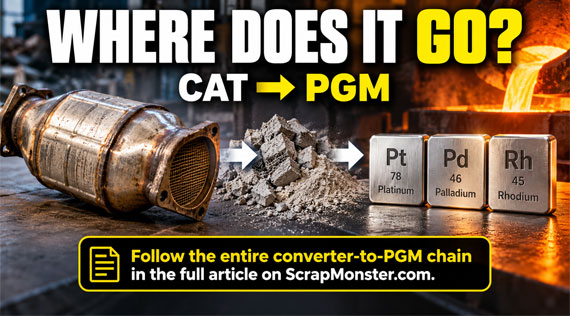
MONTREAL (Scrap Monster): Selling a catalytic converter is only the beginning of a much longer recycling chain.
The stainless-steel canister visible at the scrap yard is a container for the catalyst-bearing substrate inside. Recovering the valuable platinum-group metals requires preparation, sampling and metallurgical processing.
SCRAPMONSTER EDGE
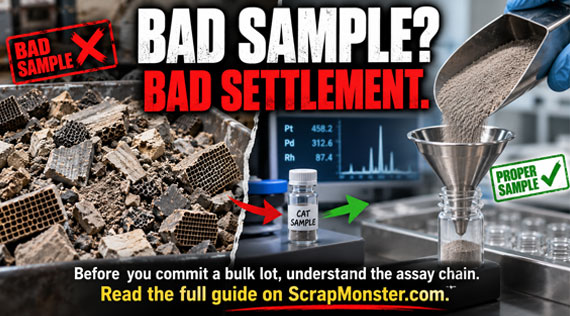
The converter's “real” bulk-lot value may not be established until after the shell is gone. In assay settlement, the critical commercial material is the prepared catalyst powder. Once the substrate is decanned, milled and homogenized, a representative sample can be used to estimate the PGM content of the entire lot.
Step 1: Identification and Intake
The buyer records the converter, verifies the seller where required and identifies the unit by code, vehicle application or buyer category.
At this stage, material may be purchased by unit price. Larger processors may instead aggregate converters for later assay settlement.
Good intake records also preserve chain of custody, condition and the relationship between the seller's lot and the material ultimately processed.
Step 2: Sorting and Aggregation
Converters may be separated by ceramic versus metallic substrate, OEM versus aftermarket category, diesel versus gasoline application or other processing characteristics.
Sorting helps processors manage different physical materials and build lots suitable for consistent preparation.
Step 3: Decanning
Decanning opens the metal housing and removes the catalyst-bearing substrate.
For ceramic converters, the honeycomb material is recovered from the shell. Metallic catalyst systems require different handling because the substrate itself is metallic.
Dust control and material capture are important because loose catalyst material can contain value and should not simply be lost during handling.
Step 4: Crushing, Milling and Homogenization
The recovered ceramic material is crushed and milled into a finer, more uniform powder.
This is not merely a size-reduction step. It helps homogenize a lot whose individual converter pieces may contain different PGM concentrations.
The more representative the blended material, the stronger the basis for sampling.
Step 5: Sampling
A processor takes one or more representative samples from the prepared lot.
This is one of the most commercially important steps in the process because the laboratory analyzes only a small sample, while the result may be used to settle the value of a much larger lot.
Sampling procedures, witness rights, retained samples and dispute procedures should be understood before material is committed under an assay contract.
Step 6: Assay
The sample is analyzed to determine the concentration of platinum, palladium and rhodium. Laboratories and refiners may use different analytical methods depending on the material and commercial agreement.
Modern PGM analysis can involve fire assay, spectroscopic techniques and mass-spectrometric methods. No single method or contract structure applies to every processor.
Step 7: Metallurgical Recovery
Industrial recovery can use pyrometallurgical routes, hydrometallurgical routes or combinations of both.
Smelting is widely used in commercial PGM recovery from spent automotive catalysts. The objective is to separate and concentrate the valuable metals from the ceramic and other material in the lot.
Further refining and purification produce marketable platinum-group metals.
Step 8: Commercial Settlement
For assay-based material, settlement normally applies the measured PGM content to the agreed metal-price basis, recovery or payable terms and contractual charges.
That is why a professional seller should understand not only the assay result but also the pricing date, payables, fees and payment schedule.
Step 9: PGMs Return to the Supply Chain
Recovered platinum, palladium and rhodium can return to industrial supply chains rather than being lost with an end-of-life vehicle.
Spent automotive catalysts are an important secondary source of PGMs because the catalyst material is substantially richer in these metals than primary ores on a concentration basis, according to recycling research.
People Also Ask
What is decanning a catalytic converter?
Decanning is the removal of the catalyst-bearing substrate from the converter's metal housing so the material can be processed.
Why is catalytic converter material milled?
Milling reduces particle size and helps homogenize a mixed lot so representative samples can be taken for analysis.
What happens to the platinum, palladium and rhodium?
After metallurgical recovery and refining, the metals can return to industrial markets as secondary PGM supply.
Is every catalytic converter settled by assay?
No. Many individual converters and small lots are purchased by unit price, while larger mixed lots may use assay-based settlement.
Final Takeaway
The converter sold at a scrap counter is the first stage of a materials-recovery chain. Identification establishes the commercial category; decanning, milling and sampling prepare the material; assay measures the PGMs; and refining turns those metals back into usable supply.
Track Catalytic Converter Scrap Prices
Follow ScrapMonster reference prices and converter categories before material enters the recycling and settlement chain.