Catalytic Converter Assay Explained: From Decanning to PGM Settlement
Catalytic Converter | 2026-09-25 15:15:08
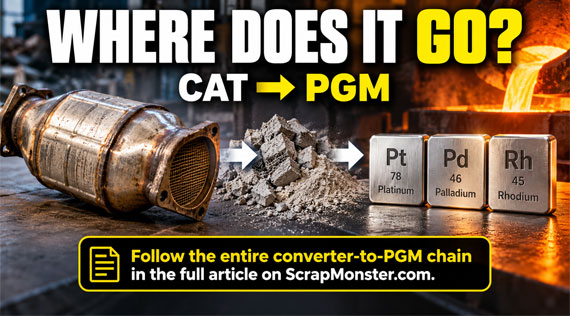
Catalytic converter assay settlement depends on more than the laboratory test. Decanning, milling, homogenization and representative sampling all affect how accurately platinum, palladium and rhodium content is measured and converted into a final settlement.
 By
By 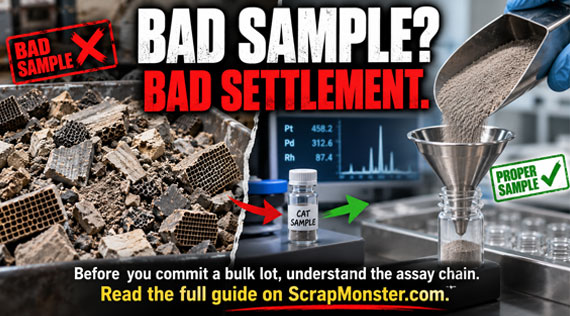
MONTREAL (Scrap Monster): Assay settlement is often described simply as “testing the converter material,” but the laboratory test is only one part of the process.
The commercial result depends on how the converters are prepared, how the lot is homogenized, how the sample is selected, which analytical method is used and how the contract converts the measured metal into payment.
SCRAPMONSTER EDGE
A precise laboratory cannot rescue a bad sample. In assay settlement, sampling representativeness can be as important commercially as the analytical method itself. If the powder sent to the lab does not represent the full lot, a highly precise test can still produce a poor estimate of the lot's true PGM content.
What Is a Catalytic Converter Assay?
An assay measures the concentration of valuable metals in a prepared sample. For spent automotive catalysts, the commercial focus is generally platinum, palladium and rhodium.
Because the laboratory cannot test every particle in a large processed lot individually, the sampling process is designed to produce a small portion that represents the whole.
Step 1: Decanning
The metal shells are opened and the catalyst-bearing substrate is removed.
For ceramic converters, the honeycomb material is separated from the steel housing. The processor must also capture loose catalyst dust and fragments because lost material can contain PGMs.
Step 2: Crushing and Milling
The ceramic substrate is crushed and milled to reduce particle size.
Individual converters can have different PGM concentrations, so a bulk lot is not naturally uniform. Milling and blending help distribute those differences through the prepared material.
Research on spent automotive catalysts emphasizes sample preparation and homogenization because they underpin representative analysis.
Step 3: Homogenization
The milled material is blended so the PGM-bearing particles are distributed as evenly as practical throughout the lot.
This stage is essential because the assay sample may represent hundreds or thousands of converters. If high- and low-grade material is not properly blended, the sampled portion may not reflect the overall lot.
Step 4: Representative Sampling
The processor takes samples from the prepared material using an agreed sampling procedure.
Commercially important questions include:
- Who controls sampling?
- Can the seller witness the procedure?
- Are duplicate or retained samples created?
- Which laboratory receives the sample?
- What happens if the parties dispute the result?
Those questions should be settled before the lot is irreversibly processed whenever possible.
Step 5: Laboratory Analysis
PGM analysis can use several established techniques. A 2026 review of spent automotive catalyst recovery discusses methods including fire assay, spectroscopic approaches, mass-spectrometric techniques, electrochemical methods and alkali fusion as part of the broader analytical toolkit.
The exact method depends on the sample matrix, laboratory, required detection limits and commercial agreement.
Sellers should ask which method supports final settlement and whether an independent umpire laboratory is available in the event of a dispute.
Step 6: Convert Assay Results Into Settlement
The assay establishes measured metal content, but it does not by itself establish the payment.
Commercial settlement may also specify:
- the platinum, palladium and rhodium price basis;
- price-fixing date or averaging period;
- recovery or payable percentages;
- treatment and refining charges;
- sampling and assay charges;
- freight or logistics charges;
- payment timing;
- minimum settlement thresholds.
A simplified framework is:
Measured PGM content × contract metal-price basis × payable/recovery terms − agreed charges = net settlement.
Actual contracts differ, so sellers should review the complete settlement sheet rather than focusing on one assay number.
Why Assay and Unit Pricing Can Produce Different Results
Unit pricing values an intact converter from its identity or buyer category before processing. Assay pricing values the processed lot from measured PGM content.
For a small group of clearly identified converters, unit pricing can be faster. For a large mixed lot, assay settlement can provide a lot-specific measurement but introduces sampling, analytical and contract considerations.
Neither method is automatically superior in every transaction.
Questions to Ask Before Sending a Lot for Assay
- Who owns the material after delivery?
- How is net processed weight established?
- How is dust captured and accounted for?
- What milling and blending procedure is used?
- How is the representative sample taken?
- Can the seller receive or retain a sample?
- Which laboratory and method are used?
- What are the payables and charges?
- Which PGM price basis applies?
- What is the dispute or umpire-assay procedure?
People Also Ask
What does assay mean in catalytic converter recycling?
It is the analytical measurement of PGM concentrations in a prepared sample from a processed converter lot.
Why are catalytic converters milled before assay?
Milling and blending help homogenize the material so a smaller sample can better represent the overall lot.
What metals are measured?
Commercial autocatalyst settlements commonly focus on platinum, palladium and rhodium.
Can sampling affect the settlement?
Yes. A sample that is not representative of the full lot can distort the estimated PGM content used for settlement.
Is assay pricing better for large lots?
It can be appropriate for larger mixed lots, but the seller should understand sampling, laboratory methods, payables, charges and price-fixing terms before choosing it.
Final Takeaway
In catalytic-converter assay settlement, the laboratory result is only as useful as the material preparation and sampling behind it. Professional sellers should understand the full chain from decanning through payment and insist on clear written commercial terms before processing begins.
Follow Catalytic Converter Market Prices
Use ScrapMonster's converter price categories and PGM market context when reviewing unit-price and assay settlement options.