 By
By 
MONTREAL (Scrap Monster): If you sell catalytic converters on assay, the laboratory result is not the same thing as your payout.
The final settlement begins much earlier — with decanning, processed weight, milling, homogenization and representative sampling — and continues after the assay through platinum, palladium and rhodium calculations, payable percentages, metal-price fixing and refinery charges.
Understanding that full chain is important because a seemingly small difference in weight, sampling or contract terms can change the commercial result of an entire converter lot.
SCRAPMONSTER EDGE
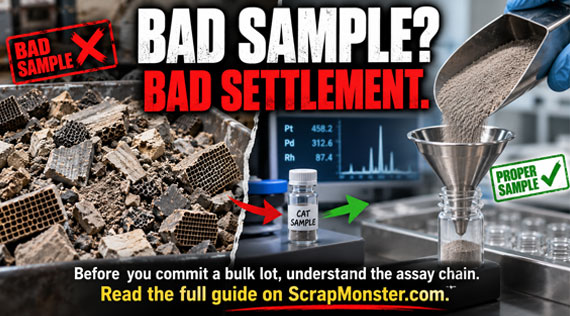
A precise laboratory cannot rescue an unrepresentative sample. Spent automotive catalyst material is not naturally uniform. If the portion sent to the laboratory does not accurately represent the processed lot, even a highly precise analytical result can produce a poor estimate of the lot's actual platinum-group-metal content.
What Is a Catalytic Converter Assay?
A catalytic converter assay measures the concentration of valuable metals in a prepared sample taken from processed converter material.
Commercial automotive-catalyst settlements generally focus on three platinum-group metals:
- Platinum (Pt)
- Palladium (Pd)
- Rhodium (Rh)
The laboratory does not test every particle from every converter. Instead, the converters are processed into a more uniform material and a much smaller representative sample is analyzed.
That assay result can then be applied to the agreed weight of the processed lot to calculate how much platinum, palladium and rhodium the lot is estimated to contain.
How Does a Catalytic Converter Assay Work?
The commercial process generally moves through seven stages:
| Stage | What Happens | Why It Matters |
|---|---|---|
| 1. Decanning | Catalyst-bearing material is removed from the metal shell. | Valuable dust, ceramic and fragments must be captured. |
| 2. Weight | The processed catalyst material is weighed. | This weight is ultimately paired with assay concentration. |
| 3. Milling | Ceramic material is crushed and reduced to a finer particle size. | Smaller particles allow more effective blending and sampling. |
| 4. Homogenization | Material from the lot is thoroughly blended. | Helps distribute high- and low-PGM material throughout the lot. |
| 5. Sampling | A small representative portion is taken from the homogenized material. | That small sample may determine the settlement value of the entire lot. |
| 6. Assay | The sample is analyzed for Pt, Pd and Rh. | Establishes measured PGM concentration. |
| 7. Settlement | Measured metal is converted into payable value under the contract. | Price basis, payables and charges determine the final payout. |
Step 1: Decanning the Catalytic Converters
Decanning opens the converter housing and removes the catalyst-bearing substrate.
In ceramic converters, this means separating the honeycomb material from the steel shell. Dust and broken fragments also need to be captured because those particles can contain platinum-group metals.
Metallic-substrate converters require different processing, but the commercial objective is the same: preserve and account for the material containing recoverable PGMs.
Step 2: Establish the Processed Weight
The lot's processed weight matters because assay concentration is eventually multiplied by the amount of material represented by the sample.
Sellers should understand exactly how the settlement weight is determined.
Important questions include whether the contract uses gross processed weight, net weight or a dry-weight basis and how moisture, foreign material or processing losses are handled.
A concentration figure without the corresponding settlement weight does not tell you how much metal is contained in the lot.
Step 3: Crushing and Milling
The ceramic substrate is crushed and milled to reduce particle size.
Individual catalytic converters can contain very different PGM concentrations. Even within catalyst material, platinum-group metals may not be distributed perfectly evenly.
Milling helps create material that can be blended more effectively before sampling.
Step 4: Homogenization
The milled material is thoroughly mixed so that material from different converters and different parts of the lot becomes as evenly distributed as practical.
This is critical because the laboratory may analyze only a very small amount of powder while the commercial result applies to hundreds of kilograms — or potentially much more — of processed catalyst.
Scientific studies of spent automotive catalysts identify material heterogeneity as an important challenge in accurately determining PGM concentrations.
Step 5: Take a Representative Sample
Once the material has been homogenized, representative samples are taken for analysis.
This is one of the most commercially important points in the entire assay process.
A professional assay agreement should make clear:
- how the sample is taken;
- who controls or witnesses sampling;
- whether the seller can observe the process;
- whether duplicate or retained samples are created;
- which laboratory receives each sample;
- how retained samples are sealed and stored; and
- what happens if the parties dispute the final result.
Those terms are best established before the lot is irreversibly processed.
Step 6: Laboratory Analysis for Platinum, Palladium and Rhodium
The prepared sample is analyzed to determine the concentration of platinum, palladium and rhodium.
Commercial and technical laboratories can use several analytical approaches, including X-ray fluorescence (XRF), inductively coupled plasma techniques such as ICP-OES, and methods that incorporate fire assay or other sample-preparation procedures.
There is no single analytical workflow used by every processor or every settlement contract.
XRF can provide rapid analysis of properly prepared material, while ICP-based and fire-assay-supported methods are also widely used for high-precision PGM determination.
The important commercial question is not simply, “Do you have an XRF?” It is:
Which analytical result governs my final settlement?
What Do ppm and g/t Mean on a Catalytic Converter Assay?
PGM concentrations on an assay report may be expressed in parts per million (ppm) or grams per metric tonne (g/t).
For concentration by mass:
1 ppm = 1 gram per metric tonne.
So an assay reporting 1,500 ppm palladium is expressing the same concentration as 1,500 g/t palladium.
This number is a concentration. It is not the number of grams or ounces actually payable from the lot until it is combined with the settlement weight.
How Do Assay Results Turn Into Platinum, Palladium and Rhodium Ounces?
The basic calculation starts with concentration and weight.
Contained grams = assay concentration in g/t × dry or settlement tonnes
Those grams can then be converted into troy ounces:
Contained troy ounces = contained grams ÷ 31.1035
The contained ounces still may not equal the payable ounces because the commercial contract can apply different recovery or payable terms to each metal.
Catalytic Converter Assay Example
Consider a simplified hypothetical lot with a settlement weight of 500 kg, or 0.5 metric tonne.
Assume the laboratory reports:
- Platinum: 800 g/t
- Palladium: 1,500 g/t
- Rhodium: 150 g/t
The estimated contained metal would be:
| Metal | Assay | Contained Grams | Approx. Troy Oz. |
|---|---|---|---|
| Platinum | 800 g/t | 400 g | 12.86 oz |
| Palladium | 1,500 g/t | 750 g | 24.11 oz |
| Rhodium | 150 g/t | 75 g | 2.41 oz |
This does not mean the seller is automatically paid for 12.86 oz of platinum, 24.11 oz of palladium and 2.41 oz of rhodium.
The next step is applying the contract's payable or recovery terms.
How the Final Assay Payout Is Calculated
A simplified settlement framework is:
Measured PGM content × settlement weight × payable percentage × contract metal price − agreed charges = net settlement
Using the hypothetical example above, if the contract specified different payable percentages for platinum, palladium and rhodium, those percentages would first be applied to the contained ounces.
The resulting payable ounces would then be multiplied by the metal-price basis specified in the contract.
The final payment can also reflect:
- treatment or refining charges;
- decanning or processing charges;
- sampling and assay fees;
- freight and logistics;
- minimum lot or settlement charges;
- price-fixing fees or hedging terms; and
- other contractually agreed deductions.
That is why two refiners can receive similar assay results but produce different final settlement amounts.
How to Read a Catalytic Converter Assay Report
A useful commercial assay or settlement statement should allow the seller to follow the calculation from material received to money paid.
| Line Item | What to Check |
|---|---|
| Processed / Settlement Weight | What weight is being valued and whether moisture adjustments apply. |
| Pt Assay | Platinum concentration, often shown as ppm or g/t. |
| Pd Assay | Palladium concentration. |
| Rh Assay | Rhodium concentration. |
| Contained Metal | Calculated grams or troy ounces represented by the lot. |
| Payable / Return | The portion of measured metal for which the seller is paid. |
| Metal Price Basis | The Pt, Pd and Rh price and the date or averaging period used. |
| Charges | Processing, refining, assay, freight or other agreed deductions. |
| Net Settlement | The final amount payable after all contract terms are applied. |
Why Can Two Catalytic Converter Assay Results Differ?
Small analytical differences can occur, but large commercial differences are not always caused by the laboratory itself.
Possible causes include:
- different samples being taken from a heterogeneous lot;
- inadequate milling or blending;
- different moisture or settlement-weight assumptions;
- lost dust or material during processing;
- different analytical preparation or methods;
- different payable percentages;
- different PGM fixing dates; and
- different refining or processing charges.
When comparing settlements, compare the complete calculation rather than only the laboratory concentrations.
XRF vs. ICP: Which Assay Method Is Better?
There is no universal answer because XRF and ICP-based techniques can serve different functions within an assay workflow.
X-ray fluorescence (XRF) can rapidly measure PGMs in properly prepared catalyst material and is widely used for process control, preliminary analysis and, in some commercial systems, assay work.
ICP-OES or other ICP-based techniques analyze prepared material after suitable sample treatment and are widely used for high-precision elemental determination.
Fire assay can also be used as a concentration or sample-preparation technique before instrumental analysis.
Published analytical research has shown that properly calibrated XRF measurements of prepared automotive catalyst material can agree closely with established ICP methods. Other research demonstrates the value of fire-assay-supported ICP analysis for complex spent-catalyst matrices.
For a commercial seller, the essential question remains: Which method and laboratory result control the settlement under the contract?
Assay Pricing vs. Unit Pricing
Assay settlement and unit pricing answer the same commercial question in different ways.
Unit pricing values an intact converter from its verified identity, part family or buyer category before it is processed.
Assay pricing values a processed lot from measured PGM content after the converters have been decanned, milled, homogenized and sampled.
Unit pricing can be practical for small quantities of clearly identified converters. Assay settlement can be useful for larger mixed commercial lots where the seller wants the material valued from measured metal content.
Neither method is automatically better for every transaction.
For a broader explanation of both systems, see How Catalytic Converter Scrap Prices Are Calculated.
10 Questions to Ask Before Sending Catalytic Converters for Assay
- How will my processed settlement weight be established?
- How are dust and loose catalyst material captured?
- How is the lot milled and homogenized?
- How is the representative sample taken?
- Can I witness the sampling procedure?
- Will I receive or retain a sealed sample?
- Which laboratory and analytical method determine final settlement?
- What are the Pt, Pd and Rh payable terms?
- How and when are PGM prices fixed?
- What is the procedure if I dispute the assay?
SCRAPMONSTER SETTLEMENT CHECK
Do not compare assay buyers using one number. A higher PGM assay does not automatically produce a higher payout if another contract offers better payables, a different fixing basis or lower charges. Compare settlement weight + assay + payable metal + PGM price basis + deductions + payment timing.
Frequently Asked Questions About Catalytic Converter Assay
What does assay mean for a catalytic converter?
An assay measures the concentration of platinum, palladium and rhodium in a representative sample of processed catalytic-converter material. The result can then be used to calculate the estimated PGM content of the complete lot.
What does ppm mean on a catalytic converter assay?
PPM means parts per million. For concentration by mass, 1 ppm is equivalent to 1 gram per metric tonne. An assay of 1,500 ppm palladium therefore equals 1,500 g/t.
How do you calculate ounces from a catalytic converter assay?
Multiply the assay concentration in grams per tonne by the settlement weight in metric tonnes to calculate contained grams. Divide the result by 31.1035 to convert grams into troy ounces.
Does an assay tell me exactly how much I will be paid?
No. The assay establishes measured PGM concentration. Final payment can also depend on settlement weight, payable percentages, PGM price-fixing terms, processing and refining charges, freight and other contract terms.
Why are catalytic converters milled before assay?
Milling reduces particle size and allows material from many converters to be blended into a more homogeneous lot. This improves the ability of a smaller laboratory sample to represent the overall material.
Can a bad sample change my catalytic converter payout?
Yes. If the laboratory sample does not represent the full lot, its PGM concentrations may not accurately estimate the metal content of the material being settled.
Is XRF the same as an ICP assay?
No. XRF measures elemental composition using X-rays, while ICP methods analyze elements using an inductively coupled plasma after appropriate sample preparation. Both can have roles in catalytic-converter analysis, and commercial contracts should identify which result controls final settlement.
Is assay pricing better than selling catalytic converters by the piece?
Not automatically. Unit pricing can be practical for smaller quantities of identifiable converters, while assay settlement can provide lot-specific measured PGM content for processed bulk material. The better commercial option depends on the converters, lot size and settlement terms.
Related Catalytic Converter Guides
How Catalytic Converter Scrap Prices Are Calculated →
How Much Is My Catalytic Converter Worth? →
What Happens to a Catalytic Converter After You Sell It? →
Final Takeaway
A catalytic converter assay is not simply a laboratory test. It is a commercial chain that begins with material preparation and representative sampling and ends with payable metal, price fixing, charges and final settlement.
For professional scrap yards, dismantlers and converter sellers, the most important protection is transparency: know the settlement weight, understand the sample, read the Pt/Pd/Rh assay, verify the payables and charges, and make sure the dispute procedure is agreed before the material is processed.
Check Catalytic Converter Scrap Prices
Compare current ScrapMonster catalytic converter categories and PGM market context before reviewing a unit-price or assay settlement.
SOURCES & METHODOLOGY
Technical explanations were reviewed against U.S. government PGM supply-chain research, peer-reviewed analytical studies of spent automotive catalysts and established industrial catalytic-converter processing workflows. The settlement example is illustrative and does not represent a price quote or a universal refinery contract. Commercial assay methods, payable terms and charges vary by processor and agreement.