 By
By 
MONTREAL (Scrap Monster): What actually happens to a catalytic converter after a scrap yard buys it?
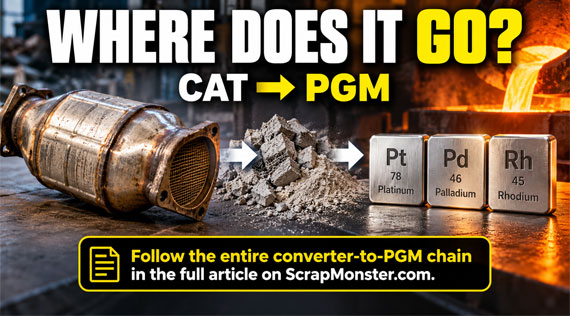
In most cases, the converter is only beginning its journey. It may move from a scrap yard or dismantler to an aggregator, specialist processor, assay operation and finally a precious-metals refinery before its platinum, palladium and rhodium return to the industrial market.
The visible stainless-steel canister is only one part of the material stream. Most of the precious-metal value is associated with the catalyst-bearing substrate inside.
SCRAPMONSTER EDGE
Your catalytic converter may change hands several times before the PGMs are actually refined. A scrap yard may identify and purchase the unit, an aggregator may combine it with other converters, a processor may decan and prepare the catalyst material, and a specialist refiner may ultimately recover the platinum, palladium and rhodium. Some integrated recyclers perform several of these stages themselves.
Where Does a Catalytic Converter Go After the Scrap Yard?
The exact route varies by buyer, region and lot size, but a typical commercial chain looks like this:
| Stage | Who May Handle It | What Happens |
|---|---|---|
| 1. Sale / Intake | Scrap yard, auto recycler or converter buyer | Converter is identified, recorded and purchased or booked into a lot. |
| 2. Aggregation | Aggregator or processor | Converters are sorted and combined into commercially practical lots. |
| 3. Decanning | Specialist processor | The steel shell is opened and the catalyst-bearing substrate is recovered. |
| 4. Milling & Sampling | Processor / sampling facility | Ceramic material is crushed, blended and sampled for analysis. |
| 5. Assay | Laboratory | Platinum, palladium and rhodium concentrations are measured. |
| 6. Recovery & Refining | Smelter / PGM refiner | PGMs are separated, concentrated and purified. |
| 7. Return to Market | Metal users and manufacturers | Refined Pt, Pd and Rh re-enter industrial supply chains. |
Does the Scrap Yard Actually Recycle the Catalytic Converter?
Usually, not all the way to finished platinum-group metal.
A scrap yard or vehicle dismantler may buy, identify, sort and store converters, but recovering the PGMs requires specialized equipment and metallurgical processing.
The converter therefore may be sold onward to a specialist catalytic-converter processor, an aggregator or an integrated precious-metals recycler.
Some larger companies control several stages of the chain, from converter purchasing and processing through laboratory testing and refining. Others specialize in only one part.
What Happens to the Metal Shell?
During decanning, the exterior housing is separated from the catalyst-bearing material.
The housing itself has scrap value and can move into the metal recycling stream.
The U.S. Geological Survey has specifically noted that catalytic-converter shells are recycled for their stainless-steel content while the internal substrate is sent onward for PGM recovery.
What Happens to the Honeycomb Inside?
For many converters, the familiar honeycomb is a ceramic monolith coated with a catalyst layer containing platinum-group metals.
Once removed from the shell, this material becomes the focus of the precious-metals recovery process.
Metallic-substrate converters follow a different preparation route because the internal support structure is metal rather than ceramic, but the objective is the same: separate and recover the PGM-bearing material.
Why Is the Converter Material Ground Into Powder?
A bulk lot can contain converters with very different PGM concentrations.
After decanning, ceramic catalyst material is commonly crushed and milled into smaller particles and thoroughly blended.
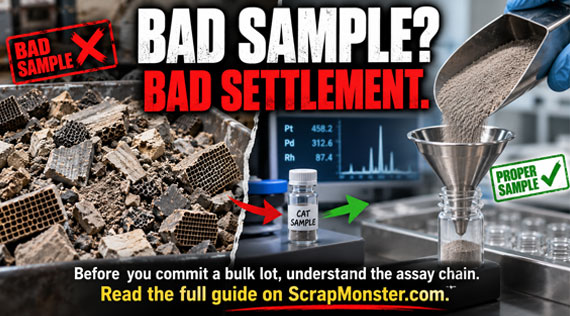
The purpose is not simply to make the material easier to handle. Milling and homogenization help create a lot from which a small sample can more accurately represent the much larger quantity being processed.
For a deeper technical explanation, see How Catalytic Converter Recycling Works: From Scrap Converter to Recovered Platinum, Palladium and Rhodium.
What Happens at the Assay Stage?
Once the catalyst material has been properly prepared and homogenized, representative samples can be analyzed for platinum, palladium and rhodium.
The assay may then be used to estimate the PGM content of the entire processed lot.
This stage is especially important for larger assay-settled lots, where the seller's final payment can depend on the sample, measured metal content and commercial settlement terms.
Because ScrapMonster has a dedicated guide to this subject, the detailed calculation is best handled separately rather than repeated here.
Read: Catalytic Converter Assay — How PGM Testing Determines Your Payout →
Where Does the Catalyst Powder Go Next?
Prepared PGM-bearing material moves to specialist metallurgical recovery and refining operations.
Commercial recovery systems can use pyrometallurgical routes, hydrometallurgical routes or combinations of both.
Large-scale PGM refining commonly involves concentrating the precious metals before further chemical separation and purification.
The exact flowsheet varies by refinery and feed material.
What Happens to the Platinum, Palladium and Rhodium?
After refining, the recovered metals are no longer “scrap.” They become secondary platinum-group metal supply suitable for industrial use.
Recycled PGMs can return to applications including:
- new automotive catalysts;
- chemical and petroleum-refining catalysts;
- electronics;
- glass manufacturing;
- medical and dental applications; and
- jewelry and other industrial products.
Automotive catalytic converters are one of the most important sources of recycled platinum, palladium and rhodium.
WHERE EACH PART ENDS UP
| Converter Material | Typical Destination |
|---|---|
| Steel Housing | Metal recycling stream |
| Ceramic / Metallic Catalyst Substrate | Specialist PGM processing |
| Milled Catalyst Material | Sampling, assay and refining |
| Recovered Pt, Pd & Rh | Industrial precious-metals market |
How Does the Seller Get Paid?
The payment method depends on the transaction.
Many individual converters are purchased using a unit price based on converter identification, category and the buyer's market model.
Larger mixed lots may instead be processed and settled using an assay-based system, in which measured PGM content is combined with agreed payable terms, metal prices and processing charges.
For a detailed breakdown, see How Catalytic Converter Scrap Prices Are Calculated →.
Why Catalytic Converter Recycling Matters to PGM Supply
Platinum-group-metal mine production is geographically concentrated, while automotive catalysts remain a major end use for platinum, palladium and rhodium.
That makes end-of-life catalytic converters an important secondary source of these metals.
Recycling does not eliminate the need for mined supply, but it returns metal that has already been produced to the market instead of losing it when a vehicle reaches the end of its life.
Common Questions
What do scrap yards do with catalytic converters?
Scrap yards may identify, purchase, sort and aggregate converters before selling them to specialist processors, aggregators or refiners. Most yards do not themselves perform the full PGM refining process.
Where do scrap yards sell catalytic converters?
Depending on the business model, converters can move to specialist catalytic-converter buyers, aggregators, decanning and sampling facilities or integrated precious-metals refiners.
Does a catalytic converter get melted whole?
Usually not. In common recycling workflows, the catalyst-bearing material is first separated from the exterior shell. The PGM-bearing material is then prepared for metallurgical recovery.
What happens to the ceramic inside a catalytic converter?
The ceramic substrate can be decanned, crushed, milled and homogenized before representative samples are analyzed and the material is sent for PGM recovery.
What happens to the stainless-steel shell?
The separated housing can be recycled as metal scrap rather than following the catalyst material through the precious-metals refinery.
Are platinum, palladium and rhodium reused?
Yes. After recovery and refining, secondary PGMs can return to automotive catalysts and other industrial markets.
Does every catalytic converter go through assay?
No. Individual converters and smaller lots are often purchased by unit price. Assay settlement is commonly used for processed commercial lots where the value is based on measured PGM content.
Related Catalytic Converter Guides
How Much Is My Catalytic Converter Worth? →
How Catalytic Converter Scrap Prices Are Calculated →
Catalytic Converter Assay: How PGM Testing Determines Your Payout →
Final Takeaway
Selling a catalytic converter at a scrap yard does not mean the recycling process is finished. It is usually the beginning of a specialized materials-recovery chain.
The shell can return to the metal recycling stream, while the catalyst-bearing substrate moves through processing, sampling and refining before its platinum, palladium and rhodium return to industrial markets.
Understanding that chain also explains why converter value cannot be judged simply by the weight or appearance of the exterior canister.
Check Catalytic Converter Scrap Prices
Review ScrapMonster converter price categories and PGM market context before selling or evaluating catalytic-converter scrap.
SOURCES & METHODOLOGY
The recycling-chain description was reviewed against U.S. Geological Survey research on platinum-group-metal recycling, U.S. Department of Energy research on catalytic-converter recovery, and established industrial converter-processing workflows. Exact commercial routes vary by recycler, processor and refinery.