How Catalytic Converter Recycling Works: From Scrap Converter to Recovered Platinum, Palladium and Rhodium
Catalytic Converter | 2026-08-03 15:24:23
Catalytic converter recycling involves identification, decanning, milling, representative sampling, laboratory assay and industrial refining. This guide explains how platinum, palladium and rhodium are measured, recovered and converted into a commercial settlement.
 By
By 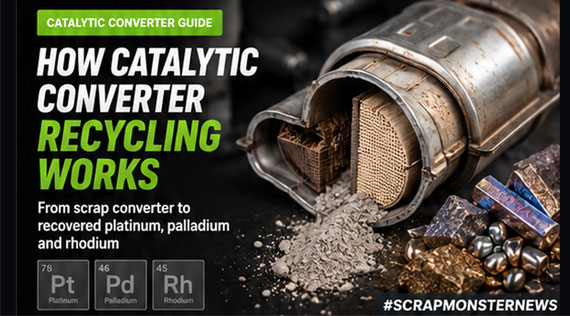
A used catalytic converter may look like an ordinary stainless steel exhaust component. Most of its recycling value, however, comes from a thin catalyst coating containing platinum-group metals, commonly platinum, palladium and rhodium.
These metals help catalytic converters transform regulated exhaust pollutants into less harmful gases. The U.S. Geological Survey identifies automotive catalytic converters as a major application for platinum-group metals.
Recovering the metals is more complicated than opening a converter and weighing the material inside. A professional recycling chain typically involves lawful collection, identification, sorting, decanning, size reduction, homogenization, representative sampling, laboratory analysis and metallurgical refining.
Each stage affects the final result. A converter may be identified correctly, but the settlement can still be unreliable when material is lost, the lot is poorly blended or the laboratory sample does not accurately represent the full batch.
Why Catalytic Converters Are Recycled
Platinum, palladium and rhodium are valued for their catalytic properties and are used in automotive emissions-control systems. End-of-life converters provide a secondary source of these metals after a vehicle is dismantled or the exhaust component is replaced.
The objective of converter recycling is not limited to recovering the exterior steel shell. The processor must separate and concentrate small quantities of valuable PGMs from a much larger mass of ceramic, metallic and base-material components.
Because converter formulations vary by manufacturer, vehicle application, model year, engine and emissions system, not every converter contains the same quantity or combination of PGMs.
What Is Inside a Catalytic Converter?
Outer Housing
The exterior shell protects the catalyst from impact, weather, heat and exhaust-system vibration. Manufacturer markings, serial numbers and part codes on the housing may also help identify the converter before processing.
Internal Substrate
Many automotive converters use a ceramic honeycomb substrate. Some use a metallic substrate. The structure creates a large surface area while allowing exhaust gas to move through the converter.
Washcoat and Catalyst Layer
The substrate carries a porous washcoat that helps disperse the active catalyst. Platinum, palladium and rhodium may be present in different combinations and concentrations.
Since the PGMs are distributed in a thin surface coating rather than a solid piece of metal, exact content cannot be established by weighing the complete converter.
Step 1: Lawful Collection and Intake Documentation
Professional recycling begins before physical processing. The buyer should establish the seller's identity and the lawful origin of the converters.
Documentation requirements differ by jurisdiction and may include seller identification, vehicle information, repair records, photographs, proof of ownership or a bill of sale. Sellers and buyers must follow the rules that apply where the transaction occurs.
A documented intake record may include:
- Seller identification
- Transaction date
- Converter photographs
- Visible serial or part numbers
- Vehicle information, when available
- Unit count and gross weight
- Purchase or settlement reference number
Accurate records support traceability when individual units are later combined into a larger processing lot.
Step 2: Identification and Sorting
Converters should be identified and sorted before they are physically processed. Common sorting factors include:
- Original-equipment manufacturer versus aftermarket construction
- Vehicle manufacturer or converter family
- Gasoline, diesel or hybrid application
- Ceramic versus metallic substrate
- Main converter versus pre-converter
- Intact, damaged, empty or partially depleted condition
- Known serial number versus unidentified unit
Sorting matters because converters with a similar exterior appearance may have different catalyst formulations and PGM concentrations.
Serial-number identification can support unit-based pricing for individual converters. Larger mixed lots may instead be processed and settled according to the measured PGM content of the complete batch.
Step 3: Decanning and Material Separation
At an appropriately equipped processing facility, the converter housing is opened and the catalyst-bearing substrate is separated from the exterior shell. This operation is commonly called decanning.
The recovered shell can enter the applicable metal recycling stream. The ceramic or metallic catalyst substrate is retained for precious-metal recovery.
Damaged converters require careful handling because loose catalyst material and dust may contain part of the lot's recoverable PGM value. A processor that fails to capture this material may reduce the measured yield.
Safety Notice
Decanning and crushing should not be performed without appropriate industrial equipment, dust collection, worker protection and material controls. Informal processing can expose workers to fine particulate matter and can result in loss of valuable catalyst material.
Step 4: Crushing, Milling and Homogenization
After decanning, ceramic substrate is generally reduced in size and milled into a powder. The material must then be blended to create a batch that is sufficiently uniform for representative sampling.
This stage is important because a mixed lot may contain converters from different manufacturers, vehicle types and operating histories. One part of an inadequately blended batch may contain a different PGM concentration from another.
A credible processor should be able to explain:
- How the material is milled and blended
- How dust and fines are captured
- How customer lots are kept separate
- How contamination between lots is prevented
- How the final laboratory sample is extracted
- Whether retained or duplicate samples are available
Step 5: Representative Sampling
Sampling is one of the most important stages in an assay-based settlement. A laboratory can analyze a sample precisely, but the result will not represent the full lot when the sample itself is biased or incomplete.
A representative system draws material from the homogenized batch and reduces it into smaller laboratory portions using controlled procedures. Depending on the commercial agreement, the divided material may include:
- The processor's sample
- The seller's sample
- The laboratory sample
- A sealed reserve or umpire sample
An umpire sample may be submitted to an agreed independent laboratory if the parties receive materially different results and have established a dispute procedure in advance.
Step 6: Laboratory Assay
An assay determines the concentration of platinum, palladium and rhodium in a prepared sample. The laboratory method depends on the processor, required precision and settlement structure.
X-Ray Fluorescence
X-ray fluorescence, commonly called XRF, can provide rapid elemental analysis of properly prepared catalyst powder. Calibration, particle size, sample preparation and matrix composition can affect the result.
ICP-Based Analysis
Inductively coupled plasma methods can measure metals after the sample has been chemically prepared or dissolved. Laboratories may use ICP optical emission spectrometry or ICP mass spectrometry, depending on their method and analytical requirements.
Fire-Assay Collection Methods
Fire-assay-based procedures use a collector phase to concentrate precious metals before instrumental measurement. Published research has evaluated these methods for determining platinum, palladium and rhodium in spent automotive catalyst material.
No analytical instrument eliminates the need for representative sampling. The reliability of a commercial result depends on the entire process, including milling, blending, sampling, calibration, analysis and reporting.
Step 7: Converting the Assay Into a Settlement
Once the assay establishes the concentration of each PGM, the processor calculates how much metal is contained in the full lot.
Basic contained-metal calculation:
Lot weight × assayed metal concentration = contained metal
The commercial settlement may then apply:
- Agreed platinum, palladium and rhodium price references
- The selected pricing date or quotation period
- The percentage of contained metal that is payable
- Treatment and refining charges
- Sampling and laboratory charges
- Transportation or handling costs
- Minimum-lot or administrative fees
- Agreed adjustments for contamination or excess moisture
- Payment timing and currency
There is no universal settlement formula used by every buyer or refiner. Two companies may offer different results for the same material because their pricing dates, payable terms, processing routes, deductions and risk allowances differ.
Before shipping a lot, obtain written answers to these questions:
- Is payment based on unit identification or final assay?
- Which PGM price reference and pricing date will be used?
- Which charges or deductions will apply?
- Will the complete assay and settlement statement be provided?
Step 8: Precious-Metal Recovery and Refining
After sampling and analysis, the bulk catalyst material enters an industrial metallurgical recovery process.
Pyrometallurgical Processing
Pyrometallurgical systems use high-temperature processing and a collector metal to concentrate PGMs into a metallic phase. The concentrated material then undergoes additional refining and separation.
Hydrometallurgical Processing
Hydrometallurgical systems use controlled chemical dissolution, separation and purification stages. These operations require specialized chemical handling, emissions controls, waste treatment and laboratory oversight.
Combined Processing
Some refining systems combine thermal concentration with later chemical separation. The recovered platinum, palladium and rhodium can return to automotive catalyst production or be used in other industrial applications.
Why Results Differ Between Converter Lots
Final results may vary because of:
- Different converter designs and manufacturers
- Different PGM formulations and loadings
- OEM and aftermarket construction differences
- Gasoline, diesel and hybrid catalyst technology
- Broken, missing or contaminated substrate
- Loss of loose material before processing
- Mixing ceramic and metallic units
- Poor homogenization or sampling
- Differences in laboratory methods
- Metallurgical processing performance
- Commercial deductions and PGM price timing
This is why exterior appearance alone is not a reliable measure of value. A large converter is not automatically a high-value converter, and a smaller specialized unit may contain a more valuable catalyst formulation.
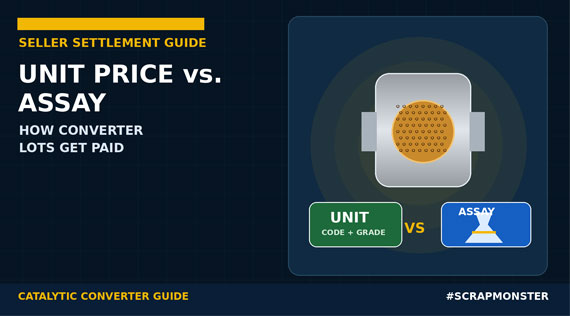
Unit Pricing Versus Assay-Based Pricing
| Pricing Method | How It Works | Common Use | Main Consideration |
|---|---|---|---|
| Unit Pricing | The buyer identifies each converter and offers a fixed price by code, family or category. | Small quantities, marked OEM units, repair shops and auto dismantlers. | Fast and simple, but the buyer's grading and database determine the offer. |
| Assay-Based Pricing | A processed lot is settled according to measured PGM content and agreed commercial terms. | Larger volumes, mixed inventories and professional aggregators. | Requires accountable sampling, transparent fees and additional processing time. |
Neither method is automatically best for every seller. The appropriate choice depends on volume, lot consistency, identification quality, turnaround requirements, fees and the written settlement terms.
Checklist for Selecting a Converter Buyer or Refiner
- Are the units purchased outright or refined on account?
- How are converters identified and graded?
- Where is the material physically processed?
- How are dust and loose catalyst material captured?
- How are customer lots kept separate?
- How is each batch homogenized?
- How is the representative sample taken?
- Which laboratory and analytical methods are used?
- Can the seller receive or retain a duplicate sample?
- How are assay disputes resolved?
- Which metal-price reference is used?
- What payable terms, fees and deductions apply?
- When will the settlement be issued?
- What proof of lawful ownership is required?
The strongest buyer relationship is not necessarily the one presenting the largest preliminary figure. Clear identification, accountable sampling, transparent deductions and reliable payment are equally important.
People Also Ask
How are catalytic converters recycled?
Professional recyclers identify and sort the converters, separate the catalyst material from the housing, mill and homogenize the material, collect a representative sample, measure PGM content and send the bulk material through an industrial refining process.
What valuable metals are recovered from catalytic converters?
The primary recoverable precious metals are platinum, palladium and rhodium. The exact combination and concentration vary by converter design and vehicle application.
What is a catalytic converter assay?
An assay is a laboratory measurement of the platinum, palladium and rhodium concentrations in a representative sample taken from a prepared converter lot.
Can a catalytic converter be valued without opening it?
A serial number, vehicle application or converter category can support a market estimate. Exact contained PGM quantities require properly prepared material, representative sampling and laboratory analysis.
Is XRF accurate for catalytic converter testing?
XRF can provide rapid elemental analysis of properly prepared catalyst material. Its reliability depends on calibration, sample preparation, particle size and whether the tested sample represents the full lot.
Why do catalytic converter buyers offer different prices?
Offers may differ because buyers use different identification methods, PGM price dates, payable percentages, processing costs, sampling procedures, fees and risk allowances.
Is it safe to process catalytic converters at home?
No. Decanning, crushing and chemical recovery can create hazardous dust, high-temperature and chemical-exposure risks. Processing should be completed by appropriately equipped and regulated industrial facilities.
What is an umpire sample in catalytic converter refining?
An umpire sample is a sealed reserve portion of the processed material that may be tested by an agreed independent laboratory if the original assay results are disputed.
Final Takeaway
Catalytic converter recycling is a chain of measurement and accountability. Identification establishes what a converter may contain. Decanning and milling prepare the catalyst material. Homogenization and sampling determine whether the assay represents the complete lot. Laboratory analysis measures the contained PGMs, and refining recovers the metals.
Sellers should look beyond a single headline offer and ask how the units are identified, how the lot will be sampled, which assay method will be used, which metal-price reference applies and what deductions are included.
Track Catalytic Converter Scrap Prices
Review current reference prices, converter categories and historical price charts on ScrapMonster.
View Catalytic Converter Scrap Prices
Published prices are reference indicators. Actual offers may vary by converter identification, condition, quantity, location and buyer terms.
Sources and Methodology
This educational guide was prepared using ScrapMonster converter-market resources and technical information from recognized government and scientific sources. Commercial practices vary by processor and jurisdiction.
- U.S. Geological Survey: Platinum-Group Metals Statistics and Information
- U.S. Geological Survey: Mineral Commodity Summaries 2026, Platinum-Group Metals
- Analytical Chemistry: XRF Determination of Platinum, Palladium and Rhodium in Spent Automotive Catalysts
- ScrapMonster: Catalytic Converter Scrap Prices