Why Catalytic Converters From the Same Car Can Have Different Scrap Values
Catalytic Converter | 2026-09-25 14:47:16
Two catalytic converters from the same vehicle can receive different scrap quotes. Position, engine and emissions configuration, OEM versus replacement status, PGM formulation and condition can all change the buyer category.
 By
By 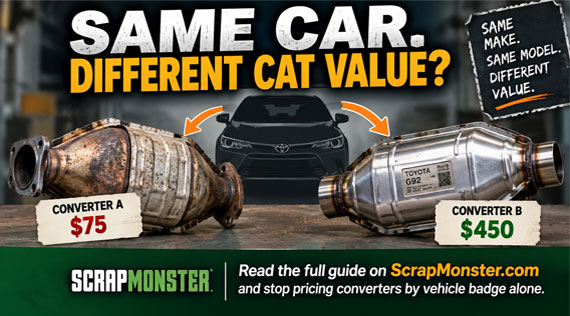
MONTREAL (Scrap Monster): One of the most common catalytic-converter pricing mistakes is assuming that every converter from the same vehicle should have the same scrap value.
Modern exhaust systems can contain several emissions-control components. Their jobs, locations, sizes and catalyst formulations can differ, which means the buyer may classify each unit separately.
SCRAPMONSTER EDGE
“Same vehicle” does not mean “same converter.” A multi-bank engine can use separate left and right close-coupled converters plus an underfloor unit. Each position can have a different part number, catalyst design and buyer grade.
Position Changes the Converter
A vehicle can use a close-coupled converter near the exhaust manifold and another converter farther downstream. V-type engines may use separate bank-specific units.
For scrap identification, record:
- front or rear position;
- left or right bank;
- manifold or underfloor location;
- pre-converter or main converter;
- oxygen-sensor location and count.
Those details can distinguish units that otherwise came from the same make and model.
Engine and Emissions Configuration Matter
Manufacturers can use different exhaust systems within the same model line. Engine displacement, fuel type, hybrid configuration, model year and emissions certification can change the converter part family.
That is why a quote based only on “Toyota,” “Ford,” “Honda” or another vehicle badge is too broad for professional grading.
Use the exact vehicle configuration and converter markings whenever possible.
OEM and Replacement History Can Split the Value
Two converters removed from the same vehicle may not even have the same history.
One may be an original-equipment unit and the other may have been replaced after a repair. A direct-fit aftermarket converter can resemble the factory unit externally while using a different catalyst formulation or loading.
Before pricing both pieces as a matched pair, verify the markings on each converter separately.
PGM Formulations Are Not Uniform
Catalytic converters use platinum-group metals, especially platinum, palladium and rhodium, to promote emissions-control reactions. The quantity and mix depend on the catalyst design and application.
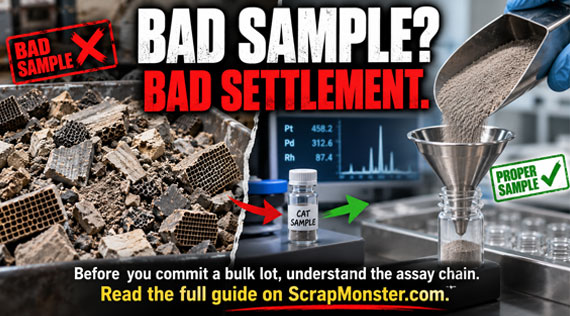
Those differences are central to recycling value. A converter's external dimensions cannot reveal its recoverable PGM content.
This also explains why a move in one PGM price does not affect every converter category in the same way.
Condition Can Separate Two Otherwise Similar Units
Even if two converters began as the same part number, their end-of-life condition can differ.
One unit may be intact while another has:
- broken honeycomb;
- missing substrate;
- heat damage or melting;
- contamination;
- loose material lost during removal or transport;
- prior cutting or tampering.
Buyers should document those differences at intake rather than assuming identical settlement.
Why Part Numbers Beat Vehicle Descriptions
A verified converter code is usually more useful than a broad vehicle description because it points to the specific part family.
When no readable code is available, combine vehicle details with position, housing design, flanges, sensor layout and photographs. If several possible matches remain, classify conservatively until the identity can be confirmed.
A Practical Example
Consider a vehicle equipped with two close-coupled converters and one downstream unit. All three came from the same vehicle, but the upstream units may be bank-specific and the downstream converter may use a separate part family.
If one upstream converter was replaced with an aftermarket unit, the lot now contains three converters from the same vehicle with potentially three different identification and pricing outcomes.
That is why professional buyers grade the units, not just the car.
People Also Ask
Can the same car have more than one catalytic converter?
Yes. Many vehicles use multiple converters or other emissions-control canisters in different positions within the exhaust system.
Are front and rear catalytic converters worth the same?
Not necessarily. Different positions can use different part numbers, catalyst formulations and buyer categories.
Can one converter on a car be OEM and another aftermarket?
Yes. Individual exhaust components can be replaced at different times, so each unit should be identified separately.
Does the vehicle VIN guarantee the converter is original?
No. The VIN helps identify the vehicle configuration but does not prove that the converter currently installed is the factory-original unit.
Final Takeaway
Do not price a catalytic-converter lot by vehicle name alone. Record each unit's code, position, construction and condition. The more precisely each converter is identified, the more defensible the quote becomes.
Compare Catalytic Converter Price Categories
Use ScrapMonster's catalytic converter price section as market context, then obtain a binding buyer quote for the specific units in your lot.