How Catalytic Converter Scrap Prices Are Calculated
Catalytic Converter | 2026-09-25 14:57:07
Catalytic converter prices are based on either verified unit identification or measured platinum-group-metal content in a processed lot. Learn how unit pricing, assay settlement, PGM markets, recovery terms and processing charges shape the final quote.
 By
By 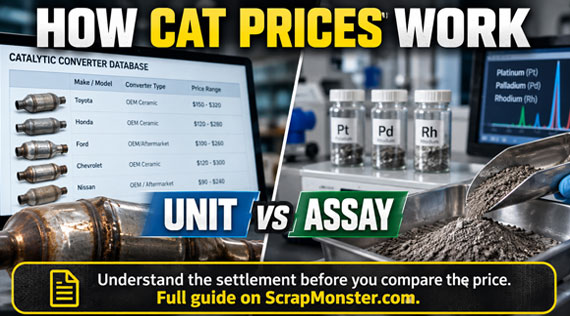
MONTREAL (Scrap Monster): Catalytic converter prices can appear opaque because buyers do not all use the same settlement method.
At the simplest level, the market is trying to estimate the recoverable value of platinum-group metals in the catalyst and then account for processing, recovery and commercial terms.
SCRAPMONSTER EDGE
The price formula changes depending on what is being sold. An intact, identifiable converter may be priced as a unit before processing. A bulk lot can be priced from homogenized material after decanning and sampling. Comparing the two requires understanding the settlement basis, not just the headline dollar amount.
Method 1: Unit Pricing
Under unit pricing, the buyer identifies each converter by serial number, part family or category and offers a fixed price per unit.
This approach is common for smaller lots, repair shops, dismantlers and recognizable OEM units because it is fast and easy to understand.
The buyer's database does the analytical work in advance. The seller is effectively accepting the buyer's historical or modeled estimate of the recoverable value for that converter family.
Key variables include:
- correct identification;
- OEM or aftermarket status;
- condition and completeness;
- current PGM market assumptions;
- buyer's expected recovery and margin.
Method 2: Assay-Based Settlement
For larger or mixed lots, a buyer or processor may decan the converters, mill the catalyst material into a more uniform powder, take representative samples and analyze those samples for platinum, palladium and rhodium.
The measured PGM content becomes the basis for settlement under pre-agreed commercial terms.
A simplified commercial framework looks like this:
Measured PGM content × agreed metal price basis × agreed payable/recovery terms − applicable processing, treatment, refining, freight or other contractual charges = settlement.
That is a conceptual framework, not a universal formula. Contracts differ by processor and lot.
Why Spot Metal Prices Do Not Equal the CAT Quote
A catalytic converter contains catalyst-coated substrate, steel or alloy housing, pipes and other materials. The listed spot price of platinum, palladium or rhodium is therefore not the price of the entire converter.
The converter also does not contain equal quantities of all three metals.
For an individual unit, the buyer must first estimate or measure how much of each PGM is recoverable. Only then can the metal-price basis be applied.
Why Sampling Matters in Assay Pricing
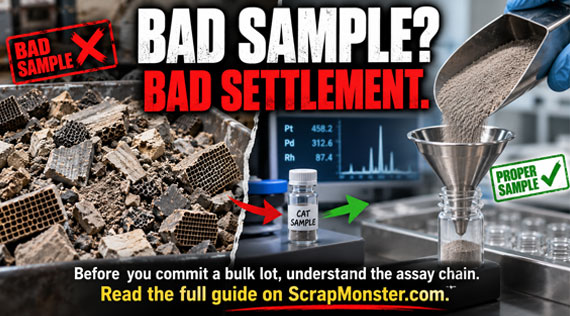
Assay settlement depends on the sample representing the entire lot.
Spent catalyst material is heterogeneous before preparation. Decanning, crushing, milling and blending are used to create a more homogeneous material from which representative samples can be taken.
Research on spent catalyst recycling consistently identifies sample preparation, homogenization and analysis as critical steps because an unrepresentative sample can distort the estimated PGM content of the whole lot.
What Can Be Deducted From Gross Metal Value
Commercial contracts vary, but sellers may encounter terms related to:
- processing or treatment;
- refining;
- sampling and assay;
- metal recovery or payable percentage;
- freight;
- minimum-lot charges;
- price-fixing date or averaging period;
- financing or payment timing.
Those terms should be agreed before material is processed whenever possible.
How to Compare Two Buyer Offers
Do not compare only the headline number.
Ask:
- Is the offer per unit or assay based?
- Who controls identification or sampling?
- Which PGM price date or averaging period is used?
- What recovery or payable percentage applies?
- What charges can be deducted?
- When is ownership transferred?
- When and how is payment made?
- What happens if the lot is disputed?
People Also Ask
How do catalytic converter buyers calculate prices?
Buyers generally use either unit identification and database pricing or assay-based settlement from measured PGM content in a processed lot.
Can I multiply the converter weight by the PGM spot price?
No. Most of the converter's weight is not platinum, palladium or rhodium, and PGM loading varies by design.
Is assay pricing always better than unit pricing?
No. The better method depends on lot size, identification quality, seller expertise, processing access and the commercial terms offered.
Why can two buyers quote different prices for the same converter?
They may use different classifications, PGM assumptions, recovery factors, processing costs, payment timing and margins.
Final Takeaway
To evaluate a catalytic-converter quote, first understand the settlement basis. Unit pricing depends heavily on identification; assay pricing depends heavily on preparation, sampling, analysis and contract terms. Both ultimately connect back to recoverable PGM value.
Track CAT and PGM Market Context
Use ScrapMonster's catalytic converter reference prices and historical data as market context before comparing buyer offers.