Scrap Industry News

Hot Recycling Categories  |  Register/Login Now

SM MarketPlace : Latest Buy Offers

SM MarketPlace : Latest Sell Offers

ScrapMonster Features

Welcome to Scrap Monster

 Join Free | Sign In
Over 10,000 Companies have joined Scrap Monster, has yours?        OPEN A FREE ACCOUNT NOW
29 Dec 2011 Last updated at 05:52:23 GMT

Commodities strengthen on positive US economic news

After getting off to a slow start, commodities strengthened as the week progressed with the DJ/UBS Commodities Futures Index up around 3% on the week as of Friday morning. Largely positive economic news in the U.S. and a surge in European Central Bank lending to European banks reportedly provided some support in the lead up to the holiday weekend.

In London, official LME 3-mo. copper started the week in negative territory at $7,302/mt before steadily advancing to $7,520/mt as of Thursday morning. Other base metals basically followed suit with LME 3-mo. aluminum climbing back over $2,000/mt by week’s end. Commodity prices in New York mostly traded higher throughout the week as well with COMEX March copper up near $3.42/lb as crude oil approached $100/bbl at the close on Thursday. Gold was an exception, with COMEX gold for February delivery back down below $1,610/to in the second half of the week after having traded as high as $1,643.70/to intra-day on Wednesday.

Amid reports of thinner trading volumes, Wall Street responded positively to the economic news as well as the Dow Industrials posted three consecutive days of gains to close at 12,169.95 on Thursday. On Friday morning, mildly positive U.S. data on personal income and spending, a solid rebound in durable goods orders and the announced agreement on the extension of the payroll tax break provided further support to commodities as market participants prepared for the holiday weekend.

At the LME,Reuters reports that the base metals mostly opened higher this morning, including firmer asking prices for official 3-mo. copper ($7,615/mt), nickel ($18,745/mt), lead ($2,010/mt) and zinc ($1,862/mt). On note, the LME will be closed on Monday and Tuesday next week for the holidays. This morning, COMEX March copper was up around 5 cents per pound to over $3.46/lb., while NYMEX crude oil for Feb delivery briefly touched the $100/bbl mark. On Wall Street, the Dow Industrials were up over 1/2 percentage point in early afternoon trading following earlier gains in European markets. The dollar firmed slightly against the Euro to $1.304 but eased against the Yen, Canadian dollar and Mexican peso.

Macro News
Leaving aside the downward revision to 3Q GDP growth to 1.8%, the economic news in the U.S. was pretty good this week. The final University of Michigan reading on consumer sentiment in December was revised higher to 69.9, initial claims for unemployment dipped to 364,000 – reportedly the lowest figure since April 2008 which brought the 4-week moving average down to 380,250.

Meanwhile, modest improvements were reported for new and existing home sales as well as personal income (+0.1%) and spending (also +0.1%) in November. In addition, durable goods orders advanced 3.8% month-on-month in November, including large gains in transportation equipment (+14.7%) and defense aircraft and parts (+12.1%). But even excluding transportation, new orders were up 0.3% and unfilled order increased 1.3% to $898.1 billion, boding well for future shipments.

Combined with the eventual, if at times baffling, resolution to the payroll tax break debate, and you can see why the markets reacted favorably this week. On the European front, the European Central Bank reported on Wednesday that, following its offer to extend lending terms to banks out to 3 years, 523 banks had signed up to borrow over 489 billion Euros, or around $640 billion.

The New York Times reported that on Tuesday, Spain’s auction of 3-month and 6-month notes garnered much better interest rates of 1.7% and 2.4%, down from 5.1% and 5.2%, respectively, one month earlier. While reports late in the week indicated that Spanish and Italian bond yields were again fluctuating, the market outlook seemed a little brighter going into the holiday weekend.

Ferrous…

Back in the U.S., our friends at Steel Market Intelligence report that AK Steel, for the second time in two weeks, announced an increase in sheet prices effective immediately, noting that although “…

AK Steel does not publish list prices… this latest increase could theoretically lift prices to $790/ton. We say theoretically because while sheet prices have been on a steady uptrend in recent weeks… Steel Business Briefing's weekly HRC price assessment is lower than current list prices, pinning transactions at $660-680/ton.

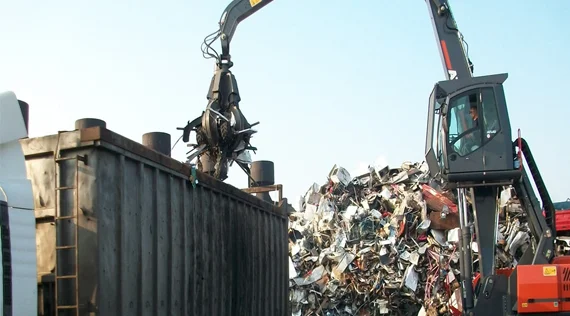
The discrepancy between list and transaction prices is not unusual.” Regarding scrap tags, Scrap Price Bulletin reported that overall average ferrous scrap prices reached an all-time high in 2011, surpassing even the banner year of 2008. This week, scrap prices were reportedly steady to firmer again, with SPB raising its composite shredded price to $451.50/gt early in the week. At week’s end, The Steel Index bumped up its reference price for shredded to $453/lt delivered Midwest, noting a discrepancy between improving market conditions in the U.S. and Turkey and easier conditions in “China, Brazil and parts of Europe.”

Schnitzer Steel Industries announced this week that it expects its fiscal 1st quarter 2012 performance to be “…lower than the outlook provided in its fourth quarter fiscal 2011 earnings release due to weaker than anticipated global market conditions for recycled metals.” The announcement goes on to say that “average inventory costs… did not keep pace with the rapid decline in average net selling prices” in the fiscal 1st quarter, which ended on November 30, 2011. Regarding their Metals Recycling Business, “operating income per ferrous ton is expected to be approximately 50% lower than the $21 per ton recorded in the first quarter of fiscal 2011.”

Nonferrous…
The International Copper Study Group (Lisbon, Portugal) reported this week that the global refined copper market was in a deficit in September (-13,000 mt) for the second consecutive month, while for the year-to-date the deficit reached 170,000 mt despite a 2.8% increase in refined production. Of note, ICSG data show that secondary refined production (production from copper scrap) increased 12% to nearly 2.7 million mt during Jan-Sep.

Last week, the International Lead and Zinc Study Group reported that, during Jan-Oct 2011, the world refined lead metal market was in a surplus of 159,000 mt while the global refined zinc metal market was in an even larger surplus of 308,000 mt. For the year to date, LME official 3-mo. asking prices for zinc and lead are down about 24% and 22%,respectively, while copper was down 21% as of this morning.

That’s pretty bleak, but note that base metal prices had a sharp run-up at the end of 2010, exaggerating the current decline. For the year as a whole, official 3-mo. copper asking prices averaged around $7,554/mt in 2010 by our calculation, as compared to around $8,841/mt so far this year, despite the continued volatility. As market activity winds down towards year end, Platts was reporting a somewhat tighter spread for burnt No.1 at 22 cents under March COMEX this week, with Bare Bright indicated at 8 cents unders and No. 2 at 38 cents under. As of Friday afternoon, March COMEX was trading around $3.47/lb.

Recovered Paper and Fiber…
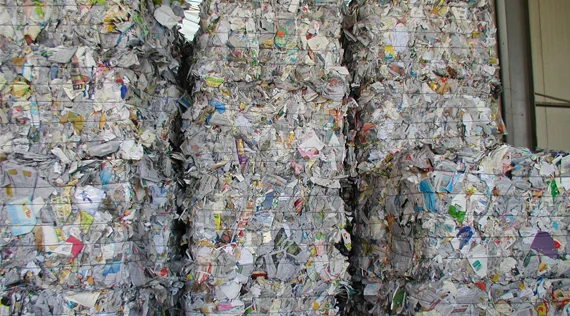
According to The Paper Stock Report, recovered paper prices continued decline in early December but may have bottomed out since. As of early this month, further declines were reported for the national average prices of Mixed paper (1) at $78.33/st, ONP deink quality (8) at $90/st, and, less severely, forOCC (11) at $125.83/st, all FOB seller’s dock. While overseas demand is “showing signs of new life”,including Chinese mill demand for OCC, considerable uncertainty reportedly remains for Chinese demand in January due in part to the Chinese New Year celebrations and timing of import license renewals.

And in case you missed it earlier, here are the details on the latest round of proposed changes to ISRI’s recovered paper specs to be considered at our upcoming board meeting in January:Public Notice ISRI Scrap Specifications The Paper Stock Industries (PSI) Chapter of the Institute of Scrap Recycling Industries, Inc., (ISRI)recently approved the following proposed amendments and changes to ISRI’s guidelines for paper stock.
Please note the following grades are to be changed for both domestic and export transactions.The proposed revised guidelines are as follows:Specialty Grades to remove and replace with “this number not currently in use” 13—S Asphalt Laminated Corrugated Cuttings 21—S New Computer Print Out 24—S Carbon Mix 26—S Unsorted Tabulating Cards 27—S Colored Tabulating Cards 28—S Carbonless Treated Ledger Other Amendments: (11) Old Corrugated Containers (OCC) Consists of corrugated containers having liners of either test liner or kraft.Prohibitive Materials may not exceed 1% Outthrows plus prohibitives may not exceed 5% (12) Double-Sorted Old Corrugated (DS OCC) Consists of double-sorted corrugated containers, generated from supermarkets and/or industrial or commercial facilities, having liners of test liner or kraft. Material has been specially sorted to be free of boxboard, off-shore corrugated, plastic, and wax.Prohibitive Materials may not exceed 1/2 of 1%.

Outthrows plus prohibitives may not exceed 2% (13) New Double-Lined Kraft Corrugated Cuttings (DLK) Consists of new corrugated cuttings having liners of either test liner or kraft. Treated medium or liners,insoluble adhesives, butt rolls, slabbed or hogged medium, are not acceptable in this grade. Prohibitive Materials None permitted Outthrows plus prohibitives may not exceed 2% (14) Fiber Cores Consists of paper cores made from either recycled paperboard and/or linerboard, single or multiple plies.Metal or plastic end caps, wood plugs, and textile residues are not acceptable in this grade.

Prohibitive Materials may not exceed 1%. Outthrows plus prohibitives may not exceed 5% (19) Kraft Grocery Bag (KGB) Consists of new brown kraft bag cuttings, sheets and misprint bags.Prohibitive Materials None permitted Outthrows plus prohibitives may not exceed 1%. (20) New Kraft Multi Wall Bag Consists of new brown kraft multi-wall bag cuttings, sheets, And misprint bags, free of stitched papers. Prohibitive Materials None permitted. Outthrows plus prohibitives may not exceed 1% (22) Mixed Flyleaf Shavings Consists of trim of magazines, catalogs, inserts and similar printed matter, not limited with respect to groundwood, uncoated or coated stock, and may contain the bleed of cover and insert card stock as well as beater-dyed paper and solid color printing. Prohibitive Materials None permitted. Outthrows plus prohibitives may not exceed 2% (27) Coated Flyleaf Shavings Consists of lightly printed trim from magazines, catalogs and similar printed matter, not limited with respect to groundwood, uncoated or coated stock.

The bleed of cover, insert card stock, and beater-dyed paper may not exceed 2%. Prohibitive Materials None permitted Outthrows plus prohibitives may not exceed 1% (35) Semi Bleached Cuttings Consists of sheets and cuttings of unprinted, untreated, groundwood-free paper such as file folder stock,untreated milk carton stock, or manila tag. Prohibitive Materials None permitted. Outthrows plus prohibitives may not exceed 2% (41) Manifold White Ledger (MWL) Consists of sheets, shavings, and cuttings of industrially generated printed or unprinted white groundwood-free paper. All stock must be uncoated. Prohibitive Materials may not exceed 1/2 of 1%. Outthrows plus prohibitives may not exceed 2%. Grade 42 – Change to “grade no longer in use” and Create Specialty grade 36-S Computer Printout (CPO) (45) Lightly Printed Bleached Board Cuttings Consists of groundwood-free printed bleached board cuttings, free from misprint sheets, cartons, wax, greaseproof lamination, metallic, and inks, adhesives or coatings that are insoluble. Prohibitive Materials may not exceed 1/2of 1%. Outthrows plus prohibitives may not exceed 2%. (46) Printed Bleached Board Consists of groundwood-free misprint sheets, cartons and cuttings of bleached board, free from wax, greaseproof lamination, metallic,and inks, adhesives or coatings that are insoluble.

Prohibitive Materials may not exceed 1%. Outthrows plus prohibitives may not exceed 2%. Specialty Grade Changes 3—S Poly Coated Cup Stock 9—S This Grade No Longer in Use ****** The guidelines will be submitted for final approval at the next ISRI Board of Directors meeting to be held at the The Mayflower Renaissance Hotel in Washington, DC on Thursday, January 19, 2012 from 1:00– 3:00 p.m.. The Board of Directors may adopt, amend or reject the proposed recommendations or table them pending further review and recommendations. Interested parties may participate in the proceeding by personal appearance or by submitting written comments to: Mr. Joseph Pickard ISRI 1615 L Street, NW, Suite 600 Washington, DC 20036-5610 JoePickard@isri.org.

GUEST CONTRIBUTOR: Lynn Reaser, Ph.D. Chief Economist Fermanian Business & Economic Institute Point Loma Nazarene University

EUROPE’S CRISIS—WHERE DO WE STAND?

Although hopes were high that Europe would make progress as its recent summit, the outcome has largely been much the same as followed previous meetings.

The world still does not believe that Europe has a plan to emerge from its problems. Fears have again climbed in financial markets that the plan to impose greater fiscal discipline on Eurozone members may not win approval and that the fund to provide financial assistance will be inadequate. The solution to Europe’s problems demands three major actions: (1) a fiscal “pact” imposing rules and discipline on member countries to keep their deficits in check; (2) a rescue fund that has enough firepower to bolster any of the weaker players; and (3) a commitment by the European Central Bank (ECB) to stand as “lender of last resort” to purchase bonds of its members states in need. Any fiscal pact must demand transparency in the reporting of economic and budget numbers. The threat of real sanctions must also be credible. The primary political objection will be the loss of sovereignty of individual countries as they surrender some control of their governments to a European entity. Resources announced to support the European Financial Stability Fund (EFSF) and the International Monetary Fund (IMF) still do not appear adequate to deal with problems in a major country such as Italy. Understandably, European taxpayers in stronger regions are loathe to pay for the fiscal laxity of some of their peers. The ECB has resisted to this point a policy that would require it to emulate the quantitative easing programs of the U.K. and U.S. (“QE2” most recently in the United States). It has questioned its legal authority and is also concerned about the loss of its political independence.

The ECB needs to see clear signs of fiscal discipline before it would consider providing massive assistance on the monetary side. Europe faces some extremely difficult decisions in the period ahead. A worse case outcome would see the exit of one of the members from the Eurozone or major credit problems or losses in some of the major banks. A credit freeze similar to that following the failure of Lehman Brothers could be the consequence. Europe already faces a recession in the coming year. A global credit crunch and downturn could accompany a deepening of financial woes on the continent.The outcome and market’s confidence in the negotiations and actions taken during coming days and weeks will be critical. The world will be watching developments in early 2012.

This Week’s Quote: “You can lead a man to Congress, but you can't make him think.” -- Milton Berle .

This Week’s Story: At my daughter’s school in Maryland, the tradition in recent years has been that the children bring a small gift for their teacher before the Christmas holiday break. So earlier this week, our girl was the first in her class to give her teacher her present: a report on the benefits of recycling and the numerous contributions the scrap recycling industry makes to the American economy.

The teacher smiled politely and thanked her. The next child in line is the daughter of a local florist that lives down the street from us. She gave the teacher a nice bouquet of flowers which the teacher seemed to really like and thanked her for. Next, the local candy-store owner's son gave the teacher a pretty box of candy. Then the supermarket manager's daughter brought the teacher a basket of assorted fruit. Finally came the son of a family that owns the local liquor store. The teacher’s eyes grew wide as the little boy brought up a big, heavy box and put it on the teacher’s desk. The teacher lifted it up and noticed that it was leaking a little bit…She touched a drop of the liquid with her finger and tasted it. "Is it beer?" she guessed. "No," the boy replied. She tasted another drop and asked, "Champagne?" "No," said the little boy. “Whiskey?” the teacher asked."Nope, it's a puppy!"

****** Have A Wonderful Season

blog comments powered by Disqus
Scrap Prices
Scrap Name
Price
High/Low