Complete Guide to Catalytic Converter Identification & Valuation: How to Identify and Price CAT Converters for Maximum Scrap Value
Catalytic Converter | 2026-01-25 15:48:25
Master the art of catalytic converter identification with this comprehensive guide from ScrapMonster's commodity analysts. Learn how to accurately identify and value over 40 converter types worth anywhere from $13 to $832 per unit. Whether you're a professional recycler, auto dismantler, or repair shop, proper identification is the key to maximizing your returns—misidentification can cost you $50-$400+ per converter.
 By
By 
Introduction
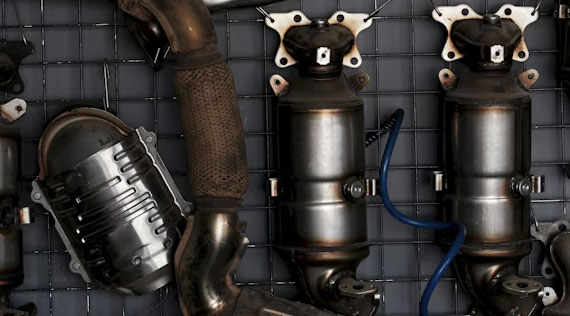
Accurately identifying your catalytic converter type is the first step to understanding its scrap value. With over 40 different converter classifications and prices ranging from $13 to $832 per unit, proper identification can mean the difference between maximizing your return and leaving money on the table. This comprehensive guide will help recyclers, auto dismantlers, and scrap dealers correctly classify converters for optimal pricing.
Whether you're a professional recycler processing hundreds of converters monthly or an auto repair shop with occasional units to sell, mastering identification techniques is essential. This guide provides the industry knowledge you need to confidently classify any catalytic converter you encounter.
Understanding Catalytic Converter Anatomy
The Three Main Components
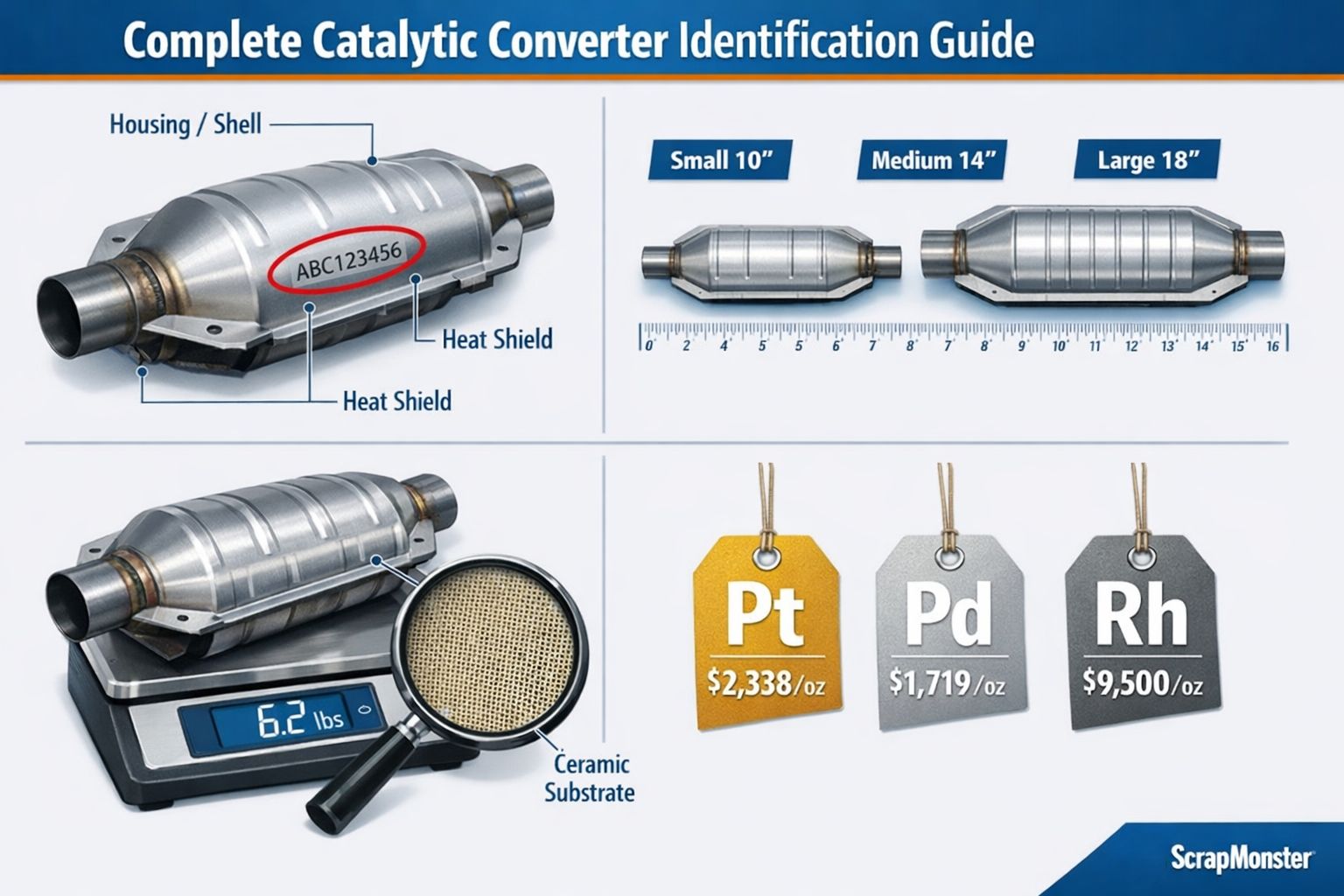
1. The Housing/Shell
The outer metal casing, typically stainless steel, protects internal components from road debris, weather, and physical damage. The housing may contain manufacturer stamps, serial numbers, and part codes—critical information for identification and valuation.
2. The Substrate/Honeycomb
This is where the value lies. The substrate is a ceramic or metallic structure with thousands of tiny channels (typically 300-600 cells per square inch) coated with precious metals. This honeycomb design maximizes surface area, allowing exhaust gases to contact the catalyst coating efficiently.
3. The Heat Shield
A protective outer layer that insulates surrounding components from the extreme heat of catalytic reactions (400-800°C). Heat shields often include manufacturer markings and are the first place to check for identification codes.
Key to Value: The Precious Metal Coating
Catalytic converters contain three platinum-group metals (PGMs):
Platinum (Pt)
- Primary catalyst in older vehicles and diesel applications
- Typical content: 3-7 grams per converter
- Current market price: $2,338 per troy ounce
Palladium (Pd)
- Dominant catalyst in modern gasoline vehicles (post-2000)
- Typical content: 2-7 grams per converter
- Current market price: $1,719 per troy ounce
Rhodium (Rh)
- Most valuable PGM, essential for nitrogen oxide reduction
- Typical content: 1-2 grams per converter
- Current market price: $9,500 per troy ounce
The ratio and total quantity of these metals determine the converter's base value, which is why accurate identification is critical for maximizing returns.
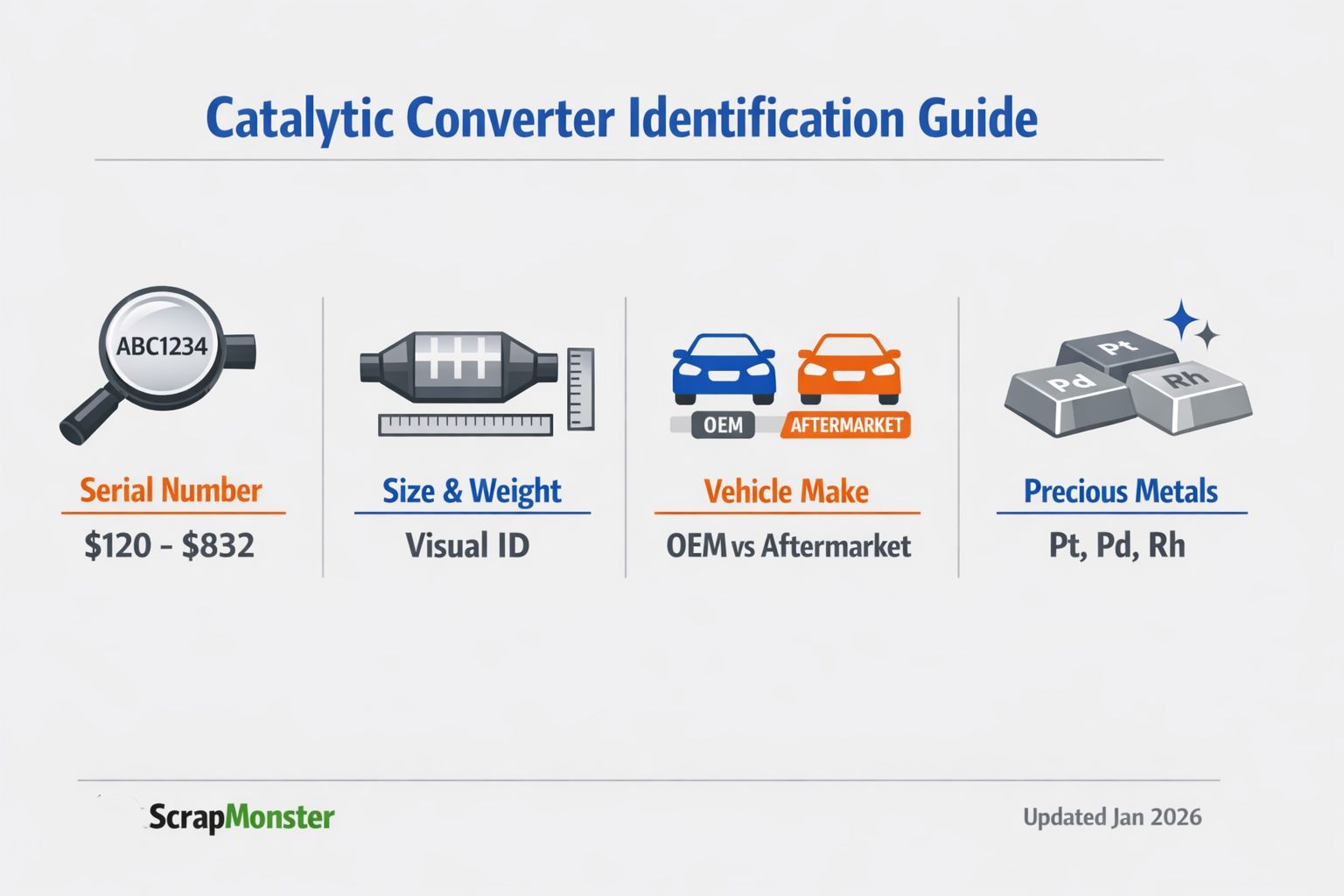
Identification Method 1: Serial Numbers & Manufacturer Codes
OEM (Original Equipment Manufacturer) Converters
Most factory converters have identifying information stamped directly on the housing. This is your most reliable identification method.
Where to Look:
- Heat shield surface (top or sides)
- End caps (inlet/outlet pipes)
- Main body between inlet and outlet
- Underneath protective shields (may need removal)
Serial Number Format Examples:
General Motors:
- Format: 8-10 digit numeric codes
- Examples: "25317499", "12672145", "15226295"
- Often stamped on circular end cap
- View GM converter pricing
Ford:
- Format: Alphanumeric with hyphens
- Examples: "DM5Z-5E212-B", "8A8Z-5G232-C", "FL3Z-5E212-B"
- Location: Usually on heat shield or body
- View Ford converter pricing
Honda/Acura:
- Format: 5 digits, hyphen, 3 letters, hyphen, 3 alphanumeric
- Examples: "18160-S10-A01", "18160-RCA-A01", "37820-RBB-003"
- Location: Stamped on main body or end flange
- View Honda converter pricing
Toyota/Lexus:
- Format: 5 digits, hyphen, 5 digits
- Examples: "17140-31150", "17101-31130", "25051-31120"
- Often includes "Denso" or "Toyota" marking
- View Toyota Camry converter pricing
European Brands (BMW, Mercedes, Audi):
- Highly variable formats
- Often include brand logo or "Bosch", "Eberspächer" markings
- Multiple small converters per vehicle common
- View Exotic converter pricing
Using Serial Numbers Effectively
Step-by-Step Process:
- Clean the converter - Use wire brush to remove dirt, rust, and grime
- Locate all markings - Check every surface, including under shields
- Photograph clearly - Take multiple angles with good lighting
- Record complete code - Include ALL letters, numbers, and hyphens
- Cross-reference - Use online databases or contact buyers with serial number
Identification Metho/scrap-companyd 2: Visual Classification
When serial numbers are missing, damaged, or unreadable, visual characteristics provide reliable identification.
Size-Based Categories
Small Converters
- Length: Under 10 inches
- Diameter: 3-4 inches
- Weight: 2-4 lbs typically
- Typical vehicles: Compact cars, 4-cylinder imports
- Examples: Honda Civic, Toyota Corolla, Nissan Sentra
- Value range: $150-$470
- ScrapMonster categories: Foreign Small ($228), Exotic Small ($472)
Medium/Regular Converters
- Length: 10-14 inches
- Diameter: 4-5 inches
- Weight: 4-7 lbs typically
- Typical vehicles: Mid-size sedans, light trucks, 6-cylinder engines
- Examples: Honda Accord, Toyota Camry, Ford F-150 (V6)
- Value range: $180-$280
- ScrapMonster categories: Domestic Regular ($180), Foreign Medium ($272), GM Medium ($192)
Large/XL Converters
- Length: 14-18+ inches
- Diameter: 5-6 inches
- Weight: 7-12 lbs typically
- Typical vehicles: Full-size trucks, SUVs, V8 engines
- Examples: Chevy Silverado, Ford F-250, Dodge RAM
- Value range: $240-$404
- ScrapMonster categories: Domestic Large ($280), Foreign Large ($333), Domestic XL ($340), Foreign XL ($404)
Torpedo/High-Flow Converters
- Shape: Distinctive cylindrical "bullet" or "torpedo" design
- Length: 12-20 inches
- Diameter: 2.5-3.5 inches (narrow)
- Weight: Varies widely (3-10 lbs)
- Typical vehicles: Performance cars, some trucks, inline exhaust systems
- Recognition: Rounded ends, inline with exhaust pipe (not offset)
- Value range: $126-$832 (extreme variation by grade)
- ScrapMonster categories: Torpedo Low Grade ($126), Torpedo Regular ($255), Torpedo Medium ($501), Torpedo High Grade ($832)
Exotic/High-Grade Converters
- Vehicles: Porsche, BMW, Mercedes-Benz, Audi, Lamborghini, Ferrari
- Characteristics: Often multiple small units per vehicle, unusually heavy for size
- Weight: 4-8 lbs (but very dense substrate)
- Substrate: Denser precious metal coating, darker appearance
- Value range: $420-$681
- ScrapMonster categories: Exotic ($541), Super Exotic ($681)
Identification Method 3: Vehicle Make & Model Reference
Domestic Converters (American Manufacturers)
General Motors (GM) Brands
Chevrolet, Buick, Cadillac, GMC, Oldsmobile, Pontiac, Saturn, Hummer
- Physical characteristics: Often rectangular or oval cross-sections
- Serial numbers: Usually 8-10 digit numeric codes
GM Converter Categories:
- GM Low Grade: $65 - Older vehicles, 4-cylinder models
- GM Regular: $120 - Standard V6 sedans
- GM Medium: $192 - Mid-size trucks, larger sedans
- GM Large: $244 - Full-size trucks, Suburban, Escalade
Common GM vehicles:
- Silverado/Sierra pickups → GM Large or GM Medium
- Malibu, Impala → GM Regular or GM Medium
- Equinox, Traverse → GM Medium
- Corvette → Often Exotic category despite being domestic
Ford Motor Company
Ford, Lincoln, Mercury brands
- Physical characteristics: Heat shields often marked with Ford logo
- Serial numbers: Alphanumeric with letter prefix
Ford Converter Categories:
- Ford Low Grade: $50 - Older or smaller vehicles
- Standard Domestic categories apply to most Ford vehicles
Common Ford vehicles:
- F-150 → Domestic Large ($280)
- Explorer, Expedition → Domestic Large ($280)
- Focus, Fusion → Domestic Regular ($180)
- Mustang → Varies: Domestic Regular to Domestic High Grade ($201)
Chrysler/Stellantis
Dodge, Jeep, Chrysler, RAM, Plymouth brands
- Physical characteristics: Variable, often similar to GM converters
Chrysler Converter Categories:
- Most classify under standard "Domestic" categories
- Jeep specific category: $211
Common Chrysler vehicles:
- RAM trucks → Domestic Large ($280)
- Grand Cherokee, Wrangler → Jeep category ($211) or Domestic Regular ($180)
- 300, Charger → Domestic Regular ($180) to Domestic High Grade ($201)
Foreign Converters (Import Manufacturers)
Honda/Acura
- Key characteristic: High precious metal content relative to size
- Substrate appearance: Dense, often darker than domestic converters
- Weight: Noticeably heavy for their compact size
Honda Converter Categories:
- Honda O2 Regular: $300
- Honda O2 High Grade: $420
"O2" Designation: Refers to oxygen sensor configuration. Most modern Hondas have two oxygen sensors (upstream and downstream of catalyst).
Common Honda/Acura vehicles:
- Accord → Honda O2 Regular ($300)
- Civic → Foreign Small ($228) or Honda O2 Regular ($300)
- CR-V, Pilot → Honda O2 Regular to High Grade ($300-$420)
- TL, MDX (Acura) → Honda O2 High Grade ($420)
Toyota/Lexus
- Key characteristic: Premium rhodium content, especially in hybrids
- Substrate appearance: Light colored, fine honeycomb structure
- Special note: Prius converters are extremely valuable and heavily targeted by thieves
Toyota Converter Categories:
- Camry Catalytic Converter: $151 (specific category)
- Most others: Foreign Small ($228), Foreign Medium ($272), Foreign Large ($333)
- Hybrid converters: Often classify as Foreign Medium to Foreign Large despite smaller size (higher PGM density)
Common Toyota/Lexus vehicles:
- Camry → Camry category ($151) or Foreign Medium ($272)
- Prius → Foreign Medium ($272) - Note: Extremely high theft target
- Tundra, Tacoma → Foreign Large ($333)
- 4Runner, Highlander → Foreign Medium to Large ($272-$333)
- Lexus RX, ES → Foreign Medium to Exotic ($272-$541)
Nissan/Infiniti
- Classification: Standard foreign categories based on size
- Characteristics: Similar to Honda/Toyota in quality
Common Nissan/Infiniti vehicles:
- Altima, Maxima → Foreign Medium ($272)
- Pathfinder, Armada → Foreign Large ($333)
- Rogue, Murano → Foreign Medium ($272)
- Infiniti Q50, QX60 → Foreign Medium to Exotic ($272-$541)
European Luxury Brands
BMW, Mercedes-Benz, Audi, Volkswagen, Volvo, Porsche
- Key characteristic: Multiple converters per vehicle (often 4-6 units)
- Substrate: Very dense, high PGM loading
- Size: Typically smaller than domestic but much heavier
European Converter Categories:
- Exotic: $541 (most common)
- Super Exotic: $681 (high-performance models)
- Volvo Special: $250 (specific to Volvo)
Important: European diesel converters are worth significantly less. Always verify fuel type.
Common European vehicles:
- BMW 3/5/7 Series → Exotic ($541), multiple units per car
- Mercedes C/E/S Class → Exotic ($541), multiple units
- Audi A4/A6/Q5 → Exotic ($541)
- Porsche 911, Cayenne → Super Exotic ($681)
- Volkswagen (gasoline) → Foreign Medium ($272) to Exotic ($541)
Identification Method 4: Physical Characteristics & Weight
Weight-to-Value Correlation
While not always linear, weight provides important valuation clues. Use a digital scale accurate to 0.1 lb for best results.
Weight Categories & Value Indicators:
Ultra-Light (Under 2 lbs)
- Likely categories: Aftermarket ($20), Diesel ($13)
- Characteristics: Minimal precious metal content, often aftermarket replacements
- Visual clues: Lighter substrate color, "universal" or "CARB compliant" markings
Light (2-4 lbs)
- Likely categories: Low grade converters ($52), Foreign Small ($228), GM Low Grade ($65)
- Characteristics: Standard 4-cylinder passenger car converters
- Value range: $50-$155
Medium Weight (4-8 lbs)
- Likely categories: Standard domestic and foreign medium/large
- Characteristics: Most common category for everyday vehicles
- Value range: $180-$340
- Examples: Domestic Regular ($180), Foreign Medium ($272), Domestic Large ($280)
Heavy (8-12 lbs)
- Likely categories: Large truck/SUV, high-grade foreign, Honda O2
- Characteristics: Dense ceramic substrate, higher PGM loading
- Value range: $300-$500
- Examples: Honda O2 High Grade ($420), Foreign XL ($404)
Extra Heavy (12+ lbs)
- Likely categories: Exotic luxury, industrial/commercial, torpedo high-grade
- Characteristics: Multiple converters in series, premium vehicles
- Value range: $420-$832+
- Examples: Exotic ($541), Torpedo High Grade ($832)
Special Cases & Problem Converters
Aftermarket Converters
Value: $20 (significantly less than OEM)
How to Identify:
- Markings: "Universal," "CARB Compliant," "Direct Fit"
- Brands: MagnaFlow, Walker, Bosal, Eastern Catalytic, AP Exhaust
- Appearance: Cleaner, newer-looking with generic housing
- Weight: Noticeably lighter than OEM equivalents
- Substrate: Lighter colored, less dense coating
- Price codes: Often stamped "49-state" or "50-state"
Why So Low?
Aftermarket converters use minimal precious metals (just enough to pass emissions testing). They contain 50-90% less PGM content than OEM factory converters.
Diesel Catalytic Converters
Value: $13 (lowest category)
How to Identify:
- Markings: "Diesel," "DOC" (Diesel Oxidation Catalyst), "DPF" (Diesel Particulate Filter)
- Size: Often very large (20+ inches)
- Appearance: Bulkier, heavier housing (but low PGM content)
- Origin: Heavy-duty trucks, diesel passenger vehicles (VW TDI, BMW diesel, Mercedes diesel)
- Substrate: May be soot-clogged (black appearance)
Why So Low?
Diesel converters use different emissions control technology. They contain primarily platinum with minimal palladium and essentially no rhodium. Total PGM content is 2-3 grams vs. 10-15 grams in gasoline converters.
Pre-Catalytic Converters (Pre-Cats)
Pre-catalytic converters are smaller secondary units located before the main converter, typically close to the engine manifold.
Pre-Cat Categories:
- Low Grade Pre Cat: $52
- Regular Pre Cat: $81
- High Grade Pre Cat: $201
- Foreign Pre Cat: $116
How to Identify:
- Size: Smaller than main converters (6-10 inches typical)
- Location: Attached close to exhaust manifold (gets hotter faster)
- Function: "Pre-heats" exhaust and starts catalytic process
- Vehicles: Often found on V6 and V8 engines (one per bank)
Value Variation: Pre-cat value depends heavily on vehicle make. Foreign pre-cats (Honda, Toyota) worth more than domestic. High-grade pre-cats from luxury vehicles can approach main converter values.
Damaged or Contaminated Converters
Melted Substrate
- Cause: Engine misfires, running too rich, excessive heat
- Appearance: Substrate fused together, channels collapsed
- Value impact: 30-70% reduction
- Reasoning: Difficult to process, lower recovery efficiency
Water Damage
- Cause: Driving through deep water, cracked housing
- Appearance: Substrate discoloration, rust inside housing
- Value impact: 10-30% reduction
- Reasoning: Contamination affects refining process
Missing Substrate
- Cause: Burned out, physically removed, extreme heat damage
- Value: Steel scrap value only (~$0.10/lb)
- Check: Look through inlet/outlet - should see honeycomb, not empty shell
Cut or Torch-Damaged Housing
- Cause: Removal from vehicle (common with stolen converters)
- Value impact: 10-20% reduction
- Reasoning: Buyers dock for additional processing difficulty
- Legal concern: Cleanly cut converters raise theft suspicion
Oil/Coolant Contamination
- Cause: Engine leaks, head gasket failure
- Appearance: Dark staining, liquid residue in substrate
- Value impact: 5-15% reduction
- Reasoning: Contaminants must be processed out during refining
Regional Variations & Emissions Standards
California (CARB) vs. Federal Converters
CARB Certification (California Air Resources Board):
- Required in California and other states with stricter emissions
- Higher precious metal loading (15-25% more PGMs)
- More expensive to manufacture
- Value: CARB converters typically worth 15-25% more than federal equivalents
How to Identify CARB Converters:
- Stampings: "CARB," "California," "CA"
- Part numbers: Often different from federal versions
- EO numbers: "Executive Order D-XXX-XXX" stamped on label
- Origin: Vehicle purchased in CARB states
CARB States (2026):
California, Colorado, Connecticut, Delaware, Maine, Maryland, Massachusetts, Nevada, New Jersey, New Mexico, New York, Oregon, Pennsylvania, Rhode Island, Vermont, Washington, District of Columbia
Cold Climate Converters
Northern Vehicle Converters:
- May have additional heating elements or insulation
- Slightly higher PGM content for cold-start performance
- Emissions testing requirements in many northern states drive quality
States with Annual Emissions Testing:
Converters from these states are typically higher quality (can't use cheap aftermarket):
- Northeast: NY, NJ, CT, MA, RI, NH, VT, ME, PA, DE, MD
- Midwest: IL, IN, WI (select counties)
- West: CA, WA, OR, NV, CO, UT
- South: VA, NC, GA, TX (select counties)
Documentation & Verification Best Practices
Before Selling - Record These Details
Create a documentation checklist for every converter or lot:
- ✅ Complete serial number with clear, close-up photos
- ✅ Vehicle make, model, year of origin (if known)
- ✅ Converter dimensions (length × diameter measured)
- ✅ Weight measurement (digital scale to 0.1 lb)
- ✅ Multiple angle photos showing overall condition
- ✅ Substrate condition photos (look through inlet/outlet)
- ✅ Any manufacturer markings or brand logos
- ✅ Your own inventory tracking number
- ✅ Date of acquisition and source
- ✅ VIN number (if available - required in many states)
Digital Organization:
- Create folders by converter category
- Name files: "Date_SerialNumber_Category.jpg"
- Maintain spreadsheet with all converter inventory
- Back up to cloud storage (Google Drive, Dropbox)
Red Flags for Buyers to Watch For
When you sell to scrap buyers, be aware of these suspicious indicators that legitimate buyers will notice:
- ❌ Serial numbers ground off or obliterated - Strong theft indicator
- ❌ Converter doesn't match claimed vehicle - Misidentification or fraud
- ❌ Fresh torch marks on recently cut converters - Theft concern
- ❌ Unrealistic quantities from non-commercial seller - Suspicious sourcing
- ❌ Evasive about origin or documentation - Legal exposure
- ❌ Pressured immediate sale - May indicate stolen property
- ❌ Cannot provide business license for commercial quantities
Protect Yourself:
- Always maintain proof of legitimate acquisition
- Document source of every converter
- Refuse to purchase converters with suspicious indicators
- Report theft concerns to local authorities
- Build relationships with verified, licensed buyers
Common Identification Mistakes to Avoid
Mistake #1: Assuming All Similar-Looking Converters Are Equal
Reality: A Toyota Camry and Honda Accord converter may look nearly identical but differ by $100+ in value.
Solution: Always verify with serial numbers or vehicle documentation. Visual similarity doesn't guarantee equal value. A Camry converter ($151) looks very similar to a Foreign Medium ($272), but the price difference is 80%.
Mistake #2: Confusing Pre-Cats with Main Converters
Reality: Pre-catalytic converters are smaller and typically worth 40-70% less than main converters.
Solution: Check converter location when removing from vehicle. Pre-cats are always closer to engine manifold. If buying converters without seeing the vehicle, ask the seller about converter position. Selling pre-cats as main converters leads to repricing disputes and damaged buyer relationships.
Mistake #3: Not Recognizing Aftermarket Replacements
Reality: Aftermarket converters ($20) look newer and cleaner but are worth 90% less than OEM units.
Solution: Check for OEM part numbers vs. generic/universal codes. Look for aftermarket brand names (MagnaFlow, Walker, Bosal). If it looks "too new" for the vehicle age, it's probably aftermarket.
Quick Test: Aftermarket converters are noticeably lighter. If an "Exotic" converter weighs 3 lbs instead of 6-8 lbs, it's aftermarket.
Mistake #4: Ignoring Condition Impact
Reality: A damaged exotic converter may be worth less than an intact domestic regular converter.
Solution: Factor condition into your classification:
- Intact substrate → Full value
- Minor damage → Dock 10-20%
- Melted substrate → Dock 30-70%
- Missing substrate → Scrap steel value only
Always disclose condition to buyers. Attempting to sell damaged converters at full price destroys credibility and results in disputed settlements.
Mistake #5: Diesel Misidentification
Reality: Diesel converters are large and impressive-looking but worth only $13—the lowest category.
Solution: Always confirm fuel type before classification. Look for "Diesel," "DOC," or "DPF" markings. If the converter came from a heavy-duty truck, commercial vehicle, or known diesel model (VW TDI, diesel Mercedes/BMW), it's almost certainly low value. Size doesn't equal value with diesel units.
Tools & Resources for Professional Identification
Essential Physical Tools
Digital Scale
- Minimum accuracy: 0.1 lb increments
- Capacity: 20-50 lbs
- Cost: $25-75
- Use: Weighing individual converters and lot totals
- ROI: Catches weight discrepancies with buyers (5-10% common)
Smartphone with Good Camera
- High-resolution photos for serial number documentation
- Enables remote quoting from multiple buyers
- Creates legal documentation trail
- Photo organization apps help manage inventory
Measuring Tools
- Caliper or tape measure
- Measure length and diameter accurately
- Helps classify borderline size categories
- Cost: $10-30
Cleaning Supplies
- Wire brush (removes rust, reveals serial numbers)
- Shop rags
- Degreaser/cleaner
- Safety gloves
- Time investment: 2-5 minutes per converter
- Value gain: 5-10% better identification and pricing
Flashlight/Work Light
- Examine substrate through inlet/outlet ports
- Check for damage, contamination, precious metal coating density
- Identify missing or melted substrate
- Cost: $15-40
Storage Organization
- Bins or pallets by category
- Labels for sorting
- Prevents mixing categories (costly error)
- Improves efficiency during sale negotiations
Digital Resources & Databases
ScrapMonster Platform
- Complete converter price listings
- Updated weekly based on precious metals pricing
- Scrap buyer directory by location
- Automotive scrap prices for related components
- Industry news and market analysis
Mobile Apps (Third-Party)
- "Cat Converter Pricer" - Serial number lookup
- "AutoCat" - Photo identification
- "ConverterLookup" - Database search
- Note: Cross-reference with multiple sources for accuracy
Manufacturer Resources
- OEM parts diagrams (dealer websites)
- Part number cross-reference guides
- Factory service manuals (identify converter location/type)
Price Tracking Tools
- Set up alerts at Kitco.com for PGM price movements
- Monitor Bloomberg Commodities for market news
- Check Investing.com for real-time precious metals quotes
Building Industry Connections
Establish Relationships with Multiple Buyers
- Get quotes from minimum 3 buyers per lot
- Compare their identification methods
- Learn from disagreements (when Buyer A says "Foreign Medium" and Buyer B says "Domestic Regular," research why)
- Build trusted buyer network through ScrapMonster directory
Join Industry Forums & Groups
- ScrapMonster community discussions
- Facebook groups: "Scrap Metal Recyclers," "Catalytic Converter Recycling"
- LinkedIn scrap industry groups
- Regional recycling associations
Attend Industry Events
- Regional scrap metal conferences
- Recycling industry trade shows
- ISRI (Institute of Scrap Recycling Industries) events
- Networking = education + buyer relationships
Consider Certification Programs
- ISRI certification courses
- Regional recycling certifications
- Environmental compliance training
- Builds credibility, improves knowledge base
Maximizing Value Through Proper Identification
The Multi-Buyer Strategy
Once you've properly identified your converters, implement this proven selling approach:
Step 1: Sort & Organize
- Separate by category (all Foreign Medium together, all GM Low Grade together, etc.)
- Count units in each category
- Calculate total weight per category
- Create professional inventory list
Step 2: Document Everything
- Photo each category pile
- Record serial numbers (at least samples from each category)
- Note any special characteristics (CARB certified, known vehicle origin, etc.)
Step 3: Request Competing Quotes
- Contact minimum 3 buyers simultaneously
- Provide identical information to each
- Request itemized pricing by category
- Ask about bulk discounts for larger quantities
Step 4: Compare & Negotiate
Example Quote Comparison:
- Foreign Medium (20 units): $265/unit = $5,300
- Domestic Regular (15 units): $175/unit = $2,625
- GM Low Grade (10 units): $60/unit = $600
- Total: $8,525
- Foreign Medium (20 units): $272/unit = $5,440
- Domestic Regular (15 units): $180/unit = $2,700
- GM Low Grade (10 units): $65/unit = $650
- Total: $8,790 (3.1% better)
- Foreign Medium (20 units): $270/unit = $5,400
- Domestic Regular (15 units): $180/unit = $2,700
- GM Low Grade (10 units): $63/unit = $630
- Total: $8,730
Winner: Buyer B
Step 5: Leverage Competition
"I have a quote from [Buyer B] at $8,790 total. Can you match or beat this pricing? I prefer working with you based on [payment speed/location/relationship], but I need competitive pricing."
Expected Result: Original best quote often improves by 2-5% through negotiation.
Volume Considerations
Small Quantities (1-20 converters)
- Focus on accurate identification
- Accept market pricing (limited negotiation leverage)
- Sell to convenient, reputable local buyers
- Priority: Speed and simplicity
Medium Quantities (20-100 converters)
- Sort by category before quoting
- Get 3+ competitive quotes
- Negotiate modest bulk discounts (3-5%)
- Consider holding during PGM price dips (if cash flow allows)
Large Quantities (100+ converters)
- Professional sorting essential
- Consider direct refinery relationships (assay settlement)
- Negotiate standing pricing agreements
- Implement price protection strategies
- Potential: 35-40% of PGM spot value vs. 25-30% for small quantities
Timing Your Sales
Monitor Precious Metals Market
Check daily pricing at:
- Platinum prices on ScrapMonster
- Palladium prices on ScrapMonster
- Rhodium prices on ScrapMonster
Optimal Selling Conditions:
- ✅ Rhodium above $10,000/oz (current: $9,500)
- ✅ Palladium above $1,800/oz (current: $1,719)
- ✅ Any PGM up 5%+ in past 5 days
- ✅ Positive market news (supply disruptions, increased demand)
Hold Strategy (If Financially Viable):
- PGM prices down 10%+ from recent peaks
- You can afford 2-6 week holding period
- Working capital not needed immediately
- Market fundamentals suggest recovery
Real Example:
- January 2026: Rhodium at $9,500/oz
- March 2021: Rhodium peaked at $29,800/oz (313% higher)
- Your 100 Foreign Medium converters in March 2021: Worth $650-750 each vs. $272 today
- Difference: $378-478 per unit = $37,800-$47,800 additional revenue on 100 units
Legal Considerations & Compliance
Documentation Requirements by State
Many states now require specific documentation for catalytic converter transactions:
Commonly Required Information:
- Seller's photo ID (driver's license scan/photocopy)
- Seller's business license (for commercial quantities)
- Vehicle VIN (when available)
- Written bill of sale with signatures
- Date and time of transaction
- Payment method documentation
Holding Periods:
Some jurisdictions require converters be held before resale:
- 3 days (some municipalities)
- 7-15 days (common state requirement)
- 30 days (strictest jurisdictions)
Why This Matters:
- Allows law enforcement to trace stolen property
- Provides cooling-off period for theft investigations
- Protects legitimate buyers from unknowingly purchasing stolen goods
Proof of Ownership
For Auto Repair Shops & Dismantlers:
- Keep repair orders showing converter replacement
- Maintain vehicle VIN linked to removed converter
- Customer signature acknowledging converter disposition
- Business license displayed and current
For Scrap Yards & Recyclers:
- Require seller identification for all transactions
- Request proof of business license for commercial sellers
- Photograph all converters before processing
- Report suspicious transactions to authorities
- Join local law enforcement "verified dealer" programs
For Individual Sellers:
- Bill of sale from vehicle purchase
- Title or registration showing vehicle ownership
- Repair receipts if converter was replaced
- Be prepared to explain why you're selling
Theft Prevention & Detection
The Catalytic Converter Theft Epidemic:
High precious metal prices (2020-2024) created unprecedented theft rates. While prices have moderated from 2021 peaks, theft remains elevated.
Most Targeted Vehicles:
- Toyota Prius (hybrid, extremely valuable converter)
- Honda Element (high ground clearance, easy access)
- Toyota Tacoma, Tundra (valuable, accessible)
- Ford F-Series trucks (high ground clearance)
- Chevrolet Silverado (high ground clearance)
Warning Signs of Stolen Converters:
- Serial numbers ground off or obliterated
- Fresh torch cut marks (vs. professional removal)
- Seller has no vehicle documentation
- Unusual quantities from non-commercial seller
- Seller wants immediate cash, no documentation
- Price too good to be true ("fire sale" pricing)
Your Responsibility:
Federal and state laws hold buyers liable for purchasing stolen property, even if purchased unknowingly. Due diligence is not optional—it's legally required.
If You Suspect Theft:
- Decline the purchase
- Document the interaction (seller info, photos if safe to do so)
- Report to local law enforcement
- Contact ScrapMonster community moderators to warn other buyers
Advanced Topics: For Professional Recyclers
X-Ray Fluorescence (XRF) Technology
What It Is:
Handheld device that uses X-rays to identify and quantify precious metal content non-destructively.
Capabilities:
- Instant PGM content analysis (30-60 seconds)
- Identifies platinum, palladium, rhodium percentages
- Detects other metals (ceramics, steel alloys)
- Creates verifiable documentation
Investment:
- Entry-level units: $15,000-$25,000
- Professional-grade: $30,000-$45,000
- Maintenance/calibration: $1,000-$2,000 annually
ROI Calculation:
- Processing 500 converters/month
- Average value dispute: 5-10% of converter value
- Dispute prevention: $6,000-$12,000 monthly
- Payback period: 2-4 months for high-volume operations
Limitations:
- Reads only surface (top 1-2mm of substrate)
- Carbon deposits interfere with accuracy
- Cannot penetrate deep into honeycomb structure
- Requires calibration and expertise to interpret
When to Invest:
- ✅ Processing 500+ converters monthly
- ✅ Frequent buyer pricing disputes
- ✅ Desire to sort inventory by actual PGM content
- ✅ Building competitive advantage through data
- ✅ Direct refinery relationships (assay settlement)
Direct Refinery Relationships
How It Works:
Skip middlemen and send converters directly to precious metal refineries for processing.
Process:
- Ship full converter lots (usually 100-500 unit minimum)
- Refinery de-cans, grinds substrate to powder
- Sample analysis determines exact PGM content
- Payment based on actual recovery minus refining fees
Advantages:
- Highest possible recovery (35-40% of spot PGM value)
- No middleman margins
- Direct settlement based on assay results
- Professional relationships with processors
Disadvantages:
- 3-6 week payment timeline (vs. immediate with local buyers)
- Requires significant working capital
- Minimum quantities required (ties up inventory)
- Price risk (PGM prices locked at settlement, not shipping)
When It Makes Sense:
- Processing 200+ converters monthly
- Strong cash position (can wait for payment)
- Sophisticated understanding of PGM markets
- High-value inventory (Exotic, Torpedo High Grade)
Conclusion: Knowledge Is Profit
In the catalytic converter recycling market, accurate identification directly translates to profit. A misidentified converter can cost you $50, $100, or even $400+ per unit. Scale that across hundreds or thousands of converters, and proper identification becomes the difference between marginal returns and substantial profits.
Key Success Factors:
Master Multiple Identification Methods
- Start with serial numbers (most reliable)
- Use visual classification for backup
- Verify with weight/density checks
- Cross-reference vehicle make/model when available
- Never rely on single method alone
Build Market Knowledge
- Monitor precious metal prices daily
- Understand PGM market drivers (supply/demand, geopolitics)
- Track current converter pricing on ScrapMonster
- Learn from every transaction (why did buyer grade differently?)
Maintain Professionalism
- Document everything thoroughly
- Build relationships with multiple verified buyers
- Comply with all legal requirements
- Report suspicious activity
- Invest in proper tools and resources
Stay Current
- Regulations change frequently (especially theft-related)
- New converter models enter market annually
- PGM prices create market volatility
- Technology improves identification methods
The Bottom Line:
Expert identification can improve your returns by 15-30% compared to sellers who guess or accept first offers. On $100,000 annual converter sales, that's $15,000-$30,000 in additional profit—simply from knowing what you have.
The converters flowing through your operation represent significant value measured in precious metals priced globally. Master the identification techniques in this guide, and you'll approach every converter with confidence, negotiate from a position of knowledge, and maximize your returns in this valuable secondary materials market.
Frequently Asked Questions (FAQs)
General Identification Questions
Q: What's the difference between OEM and aftermarket catalytic converters?
A: OEM (Original Equipment Manufacturer) converters are factory-installed units containing 10-20 grams of precious metals and worth $100-$800+ depending on type. Aftermarket converters are replacement units containing minimal precious metals (just enough to pass emissions) and worth only $20. Aftermarket units are lighter, have generic markings like "Universal" or brand names like MagnaFlow/Walker, and lack OEM serial numbers.
Q: Why are diesel catalytic converters worth so little?
A: Diesel converters use different emissions technology (DOC or DPF) and contain only 2-3 grams of precious metals (primarily platinum, almost no rhodium) compared to 10-15 grams in gasoline converters. Despite their large, impressive size, they're worth only $13—the lowest category. Always verify fuel type before classifying a converter.
Q: How do I know if my converter is high-grade or low-grade?
A: High-grade converters feel heavy for their size, have dense dark substrates visible through the ports, often come from luxury/performance vehicles, and command prices of $400-$800+. Low-grade converters are lighter, have lighter-colored substrates, come from economy vehicles or older models, and are worth $50-$120. Vehicle origin is the best indicator—a BMW converter is Exotic ($541), while an older GM 4-cylinder is GM Low Grade ($65).
Q: Can I look up a catalytic converter by VIN number?
A: Not directly, but the VIN tells you the vehicle's exact make, model, year, and engine type, which allows accurate identification. Use free VIN decoder websites to get vehicle specifications, then match the vehicle to converter categories. For example, a VIN showing a 2015 Honda Accord V6 would indicate a Honda O2 Regular or High Grade converter ($300-$420).
Value & Pricing Questions
Q: Why is my quote lower than ScrapMonster's listed price?
A: ScrapMonster prices represent reference market rates. Your actual quote may vary based on: converter condition (damage reduces value 10-70%), buyer's current inventory needs, your location/transportation costs, precious metals market fluctuations, quantity discounts, and your relationship with the buyer. Small variations (5-10%) are normal; larger discrepancies suggest misidentification or non-competitive buyer.
Q: How much are catalytic converters worth in scrap?
A: Values range from $13 to $832 per unit depending on type:
- Low value: Diesel ($13), Aftermarket ($20), Low Grade ($50-65)
- Mid value: Domestic Regular ($180), Foreign Medium ($272), Domestic Large ($280)
- High value: Honda O2 High Grade ($420), Exotic ($541), Super Exotic ($681), Torpedo High Grade ($832)
Check current pricing as values fluctuate with precious metals markets.
Q: What makes some catalytic converters more valuable than others?
A: Value is determined by precious metal content (platinum, palladium, rhodium). Luxury vehicles use more PGMs for performance/emissions, hybrid vehicles use higher-density catalysts, and newer vehicles meet stricter emissions standards requiring more precious metals. A Toyota Prius converter contains 2-3X more rhodium than a standard sedan, explaining its high theft rate and $272+ value.
Q: Do catalytic converter prices change often?
A: Yes. Prices fluctuate based on precious metals markets. Rhodium, palladium, and platinum prices change daily. ScrapMonster updates converter pricing weekly to reflect current market conditions. Major price swings can occur when geopolitical events disrupt mining (South Africa, Russia) or when automotive production changes dramatically.
Q: How can I get the best price for my catalytic converters?
A: Follow these steps:
- Accurately identify each converter using this guide
- Clean and photograph all units with serial numbers visible
- Sort by category and weigh each lot
- Get quotes from 3+ buyers through ScrapMonster's buyer directory
- Time sales when precious metal prices spike (rhodium >$10,000/oz)
- Negotiate using competing quotes
- Build long-term relationships with top buyers for preferred pricing
Vehicle-Specific Questions
Q: How do I identify a Honda catalytic converter?
A: Honda converters have distinctive serial numbers (format: 12345-XXX-XXX) stamped on the body, are notably heavy for their size, have very dense substrates, and typically fall into Honda O2 Regular ($300) or Honda O2 High Grade ($420) categories. The "O2" refers to oxygen sensor configuration. High-grade units come from Accord V6, Pilot, Odyssey, and Acura models.
Q: What are Toyota Prius catalytic converters worth?
A: Toyota Prius converters typically fall into Foreign Medium category ($272), though some grade as Foreign Large depending on model year. Prius converters contain exceptionally high rhodium content due to hybrid technology requiring extremely efficient emissions control. This high value makes them the #1 target for converter theft nationwide.
Q: Are GM catalytic converters worth anything?
A: Yes. GM converters range from $65 to $244 depending on type:
- GM Low Grade: $65 (older 4-cylinder)
- GM Regular: $120 (standard sedans)
- GM Medium: $192 (mid-size trucks, larger vehicles)
- GM Large: $244 (full-size trucks, SUVs like Silverado, Suburban, Escalade)
Q: What vehicles have the most valuable catalytic converters?
A: The most valuable converters come from:
- Luxury/exotic vehicles: BMW, Mercedes, Porsche, Ferrari → Exotic ($541) or Super Exotic ($681)
- Honda V6 models: Accord V6, Pilot, Odyssey → Honda O2 High Grade ($420)
- High-performance trucks: Ford F-250 diesel (despite diesel's low value), Dodge RAM → Torpedo High Grade ($832)
- Hybrid vehicles: Toyota Prius, Camry Hybrid → Foreign Medium/Large ($272-$333)
Condition & Damage Questions
Q: Is a rusty catalytic converter still worth money?
A: Yes. External rust on the steel housing doesn't significantly affect value—the precious metals are inside the ceramic substrate. Clean the rust to reveal serial numbers for identification. However, if rust has penetrated to the substrate (cracked housing, water damage), value may be reduced 10-30%. The substrate itself rarely rusts as it's ceramic coated with platinum-group metals.
Q: What if my catalytic converter is cut or damaged?
A: Cut or torch-damaged housings typically reduce value 10-20% due to additional processing difficulty for buyers. However, if the substrate inside remains intact, the converter retains most of its value. Melted, cracked, or missing substrate reduces value 30-70% or more. Always disclose damage when getting quotes. Note: cleanly cut converters raise theft concerns—maintain documentation proving legitimate ownership.
Q: Can I sell a catalytic converter that's been hollowed out?
A: No. If the substrate (honeycomb interior) has been removed, the converter has essentially zero scrap value—only the steel housing weight (~$0.10/lb as scrap steel). The precious metals are in the substrate coating, not the housing. Some sellers mistakenly remove substrates thinking they can sell separately, but this dramatically reduces total value and creates processing challenges.
Legal & Compliance Questions
Q: Do I need ID to sell a catalytic converter?
A: Yes, in most jurisdictions. Due to the theft epidemic, most states now require photo ID (driver's license), and many require additional documentation: business license for commercial sellers, vehicle VIN, bill of sale, and seller signature. Requirements vary by state and even by municipality. Legitimate scrap buyers will always request ID—buyers who don't may be operating illegally or purchasing stolen goods.
Q: Is it illegal to sell catalytic converters?
A: No, selling converters legally obtained is completely legal. However, selling stolen converters is illegal, and buying stolen converters (even unknowingly) can result in criminal liability. Maintain documentation proving legitimate acquisition: repair orders, vehicle titles, bills of sale, business licenses. Many states have specific converter-selling regulations—consult local laws or work with verified ScrapMonster buyers who understand compliance requirements.
Q: How can I tell if a catalytic converter is stolen?
A: Red flags include: serial numbers ground off or obliterated, fresh torch marks (stolen converters are cut from vehicles), seller cannot provide vehicle documentation or proof of ownership, suspicious quantities from non-commercial sources, seller pressures immediate cash sale with no paperwork. If you suspect theft, decline the purchase and report to local law enforcement. Never purchase converters without proper documentation.
Q: What documentation should I keep when selling converters?
A: Maintain records for minimum 5 years:
- Photos of all converters with serial numbers visible
- Weight measurements and condition notes
- Seller information (if you acquired from others)
- Vehicle VIN when available
- Bills of sale with signatures and dates
- Payment records (checks, wire transfers, not just cash)
- Buyer information and business license numbers
- Any correspondence or quotes
This documentation protects you legally and helps resolve pricing disputes.
Technical & Processing Questions
Q: What are catalytic converters made of?
A: The outer shell is stainless steel or aluminized steel. The substrate (honeycomb) is ceramic (cordierite) or metallic (stainless steel mesh). The valuable component is the microscopic coating of precious metals: platinum, palladium, and rhodium. A typical converter contains 3-7g platinum, 2-7g palladium, and 1-2g rhodium—worth $800-$1,500 at current spot prices, though scrap buyers pay 25-35% of spot value after processing costs.
Q: Can catalytic converters be recycled?
A: Yes, 100% of the precious metals can be recovered through industrial recycling. Converters are de-canned (substrate removed from housing), ground to powder, sampled, then refined using chemical or smelting processes to separate platinum, palladium, and rhodium. Recovery rates exceed 95%. Recycled PGMs are chemically identical to newly mined metals and are reused in new catalytic converters, creating a closed-loop system. Check automotive scrap prices for related recyclable components.
Frequently Asked Questions
- How can I identify a catalytic converter without a serial number?
Use a combination of visual classification methods: measure the size (length and diameter), weigh it on a digital scale, examine the substrate density through the inlet/outlet ports, and consider the vehicle of origin if known. Cross-reference these factors with ScrapMonster's converter categories. For example, a 10-inch converter weighing 6 lbs from a Honda Accord is likely a Foreign Medium or Honda O2 Regular category.
- What's the difference between OEM and aftermarket catalytic converters?
OEM (Original Equipment Manufacturer) converters are factory-installed units containing 10-20 grams of precious metals and worth $100-$800+ depending on type. Aftermarket converters are replacement units containing minimal precious metals (just enough to pass emissions) and worth only $20. Aftermarket units are lighter, have generic markings like "Universal" or brand names like MagnaFlow/Walker, and lack OEM serial numbers.
- Why are diesel catalytic converters worth so little?
Diesel converters use different emissions technology (DOC or DPF) and contain only 2-3 grams of precious metals (primarily platinum, almost no rhodium) compared to 10-15 grams in gasoline converters. Despite their large, impressive size, they're worth only $13—the lowest category. Always verify fuel type before classifying a converter.
- How do I know if my converter is high-grade or low-grade?
High-grade converters feel heavy for their size, have dense dark substrates visible through the ports, often come from luxury/performance vehicles, and command prices of $400-$800+. Low-grade converters are lighter, have lighter-colored substrates, come from economy vehicles or older models, and are worth $50-$120. Vehicle origin is the best indicator—a BMW converter is Exotic ($541), while an older GM 4-cylinder is GM Low Grade ($65).
- Can I look up a catalytic converter by VIN number?
Not directly, but the VIN tells you the vehicle's exact make, model, year, and engine type, which allows accurate identification. Use free VIN decoder websites to get vehicle specifications, then match the vehicle to converter categories. For example, a VIN showing a 2015 Honda Accord V6 would indicate a Honda O2 Regular or High Grade converter ($300-$420).