Catalytic Converter With No Serial Number? How to Identify It
Catalytic Converter | 2026-09-25 14:27:24
A missing or unreadable serial number does not automatically make a catalytic converter unidentifiable. Learn how vehicle information, converter position, shell construction, sensor layout, partial markings and substrate condition can help narrow the match without guessing.
 By
By 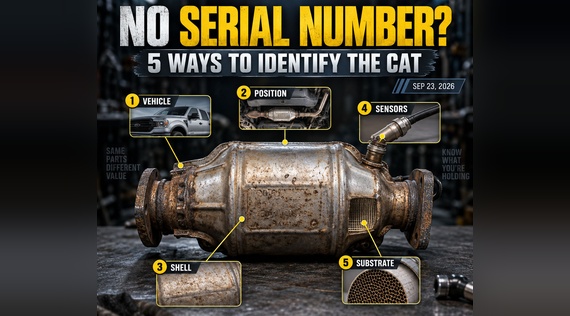
MONTREAL (Scrap Monster): Serial and part numbers are the fastest way to identify many catalytic converters, but real-world scrap does not always arrive with a clean, readable code.
Heat cycling, corrosion, road damage, cutting and previous handling can obscure shallow markings. Some replacement converters also use codes that do not appear in an OEM-focused database. When that happens, the correct response is not to guess. It is to build the identification from the remaining evidence.
SCRAPMONSTER EDGE
Think in patterns, not guesses. When the code is missing, use five independent clues together: source vehicle, converter position, shell shape, connection and sensor layout, and substrate condition. One clue can mislead; several agreeing clues create a much stronger identification.
1. Start With the Source Vehicle
If the converter was removed from a known vehicle, record the year, make, model, engine and fuel type. Capture the VIN when lawful and available. NHTSA's public VIN decoder can help confirm manufacturer-reported vehicle details for U.S.-market vehicles.
Vehicle information narrows the possible converter family, but it does not prove the installed unit is original. A vehicle may have received an aftermarket replacement years earlier.
2. Record the Converter Position
Many vehicles use more than one emissions-control canister. A close-coupled or pre-converter near the engine can differ substantially from an underfloor main converter, even when both came from the same vehicle.
Record whether the unit came from the front or rear bank, left or right side, manifold area or underbody exhaust. For multi-converter systems, position can be as important as the vehicle model itself.
3. Photograph the Complete Physical Layout
Take clear photographs before cleaning or cutting the converter. Include both sides, inlet and outlet pipes, flanges, brackets, heat shields and oxygen-sensor ports.
Useful identification clues include:
- overall shell shape and proportions;
- number and location of oxygen-sensor ports;
- flange shape and bolt pattern;
- pipe diameter and bends;
- heat-shield design;
- weld pattern and seams;
- mounting brackets and hangers;
- any partial characters, logos or labels.
A direct-fit aftermarket converter can closely resemble an OEM unit. Physical appearance therefore supports identification but should not be treated as proof by itself.
4. Use Partial Codes Carefully
A few readable characters may still be useful. Photograph them under bright, angled lighting and transcribe exactly what can be seen, including spaces, slashes and dashes.
Search both the exact form and a normalized version without punctuation if the database supports it. Do not fill in missing characters from memory or from a visually similar converter.
If corrosion is heavy, remove only loose dirt with a gentle brush. Grinding or aggressive sanding can erase shallow stamps permanently.
5. Check the Substrate and Condition
Look through the openings with adequate lighting without destroying an intact converter. Note whether the substrate is present, broken, melted or missing and whether it appears ceramic or metallic.
Condition matters because an empty or partially depleted shell cannot be valued like an intact converter of the same family.
Substrate appearance should not be used to estimate platinum-group-metal content visually. The precious metals are present in the catalyst coating and cannot be reliably quantified by looking at the honeycomb.
When to Stop Trying to Force a Match
If the vehicle history is uncertain, the code is unreadable and the physical characteristics fit several converter families, the defensible answer may be that the unit remains unidentified.
At that point, submit the photographs and source information for manual review or place the unit in an appropriate conservative buyer category. A wrong high-value identification can create pricing disputes, inventory errors and settlement problems later.
Photo Checklist for Manual Identification
- Full converter from both sides.
- Close-up of every remaining mark or label.
- Inlet and outlet openings.
- Flanges and mounting brackets.
- Every oxygen-sensor port.
- Heat shields and weld seams.
- Damage, cutting or missing substrate.
- Vehicle information and converter position when known.
People Also Ask
Can a catalytic converter be identified without a serial number?
Sometimes. Vehicle information, converter position, physical construction, sensor layout, flanges and partial markings can narrow the identification, but uncertain units should not be forced into a specific high-value category.
What if the serial number is rusted off?
Photograph the area under angled light and remove only loose corrosion gently. Avoid grinding or sanding because shallow characters can be destroyed.
Can I identify a converter by shape alone?
Shape is useful but not conclusive. Similar housings can be used across different applications and direct-fit aftermarket units can resemble OEM converters.
Does the VIN identify the exact converter?
The VIN can help confirm the vehicle configuration, but it does not prove that the converter currently installed is the original factory unit.
Final Takeaway
When a catalytic converter has no readable serial number, build the identification from several independent clues rather than one visual match. Document what is known, photograph the entire unit and classify uncertain material conservatively until a qualified buyer can confirm it.
Check Catalytic Converter Scrap Prices
Compare ScrapMonster reference categories and historical catalytic converter price data before requesting a binding buyer quote.