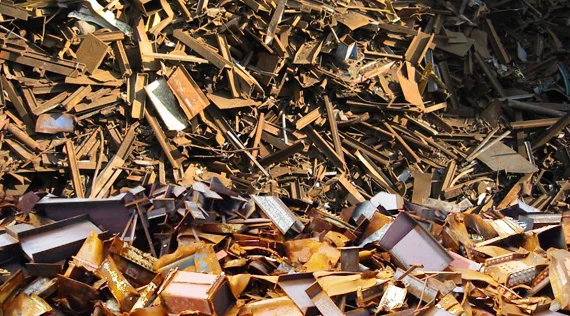
Scrap Metal Prices: Weekly Market Report- June 19-25, 2026
Weekly Metal Price Report | 2026-06-26 13:20:21
Copper scrap markets exhibited a steep decline in prices during the week, with select categories remaining stable compared to the previous week.
 By
By 
MONTREAL (Scrap Monster): This report examines the latest developments in the North American scrap metal market by tracking price movements across major scrap categories during the week of June 19–25, 2026. The analysis is based on data from the Scrap Monster Price Index and highlights week-over-week changes, offering insights into prevailing market trends and pricing dynamics.
KEY TAKEAWAYS
- Copper scrap markets exhibited a steep decline in prices during the week, with select categories remaining stable compared to the previous week.
- Aluminum scrap prices recorded mixed performance during the week, although most grades moved lower compared to the previous week.
- The brass scrap market registered a slight week-on-week decrease.
- Stainless steel scrap prices registered a decline during the week.
- Steel scrap prices recorded a jump during the course of the week, supported by consistent demand from steel mills and sufficient scrap supply across the market.
Copper scrap prices edged lower during the week, with most grades recording notable decline while a handful of key categories registered no change on the Index. The top losers were Sealed Units and Starters, which fell sharply by ↓6.25% each from the previous week.
Aluminum scrap prices posted a modest week-on-week decline on the Scrap Monster Price Index, with most tracked grades moving lower. However, Al/Cu Radiators and Al/Cu Radiators/Fe bucked the broader trend, holding steady during the period.
Brass and bronze scrap prices posted modest declines on the Index, reversing the flat trend witnessed during the previous week. In the meantime, lead scrap markets remained stable, with no price variations reported across key regional markets.
Zinc scrap prices moved lower during the week. New Zinc Die Cast and Old Zinc Die Cast both edged down on the Scrap Monster Price Index, reflecting a softer weekly tone in North American zinc scrap. Meanwhile, the global steel scrap benchmarks edged higher after remaining unchanged for several weeks in a row.
Stainless steel scrap prices recorded a downward trend on the Index during the period under review.
For full market breakdowns, visit the Daily Scrap Metal Price Report Hub or track real-time prices via the US Scrap Price Index.
NON-FERROUS SCRAP
Market Drivers
Industrial Demand
Consumption from construction, automotive, electrical equipment, machinery, aerospace, and consumer electronics sectors largely determines demand for metals such as copper, aluminum, zinc, nickel, and lead.Energy Transition
The expansion of renewable energy, electric vehicles (EVs), battery storage, and power transmission networks significantly boosts demand for copper, aluminum, nickel, lithium, cobalt, and other non-ferrous metals.Global Economic Growth
Economic expansion increases manufacturing, infrastructure development, and consumer spending, driving higher metal consumption. Economic slowdowns generally weaken demand and prices.Recycling and Scrap Availability
The availability of recycled metals influences primary metal demand. Increased scrap collection can ease supply shortages, while limited scrap availability often supports higher prices for both scrap and refined metals.Government Policies and Trade Measures
Tariffs, export restrictions, environmental regulations, mining policies, sanctions, and carbon reduction initiatives can alter supply chains, production costs, and international trade flows.Currency Movements and Interest Rates
Since most metals are priced in U.S. dollars, a stronger dollar generally makes metals more expensive for international buyers, while interest rates influence investment demand and inventory financing costs.
The above factors are likely to collectively determine the direction of the non-ferrous metals market, with supply-demand fundamentals remaining the most influential over the long term.
COPPER SCRAP PRICES
- COMEX Copper Futures closed at USD 6.0543 per pound as of June 25, 2026, modestly lower by around 30¢ (↓4.46%) over the prior week.
- According to the London Metal Exchange, LME Copper 3-month contract's closing price stood at $13,270.00 per tonne.
Market Highlights
North America Copper Scrap Prices: Copper scrap prices moved lower during the week as subdued trading activity and restrained buying interest continued to pressure the market. Leading the declines, #1 Copper Bare Bright fell by ↓4.01%, followed by #1 Copper Wire and Tubing, which slipped ↓4.08%. Meanwhile, #2 Copper Wire and Tubing posted the steepest decline among the major grades, dropping ↓4.15% over the previous week.
Charts
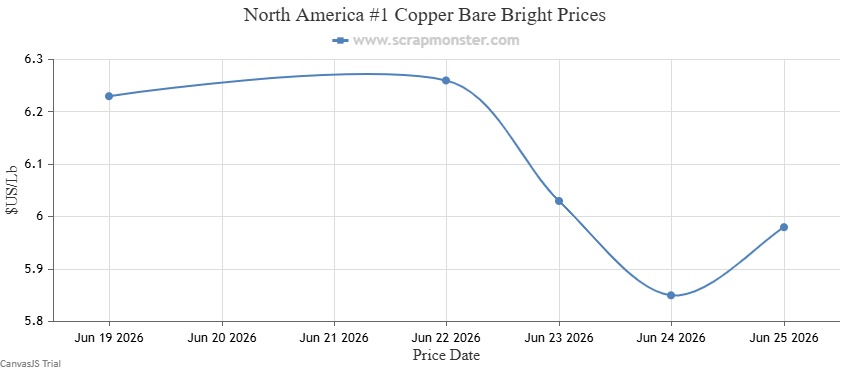
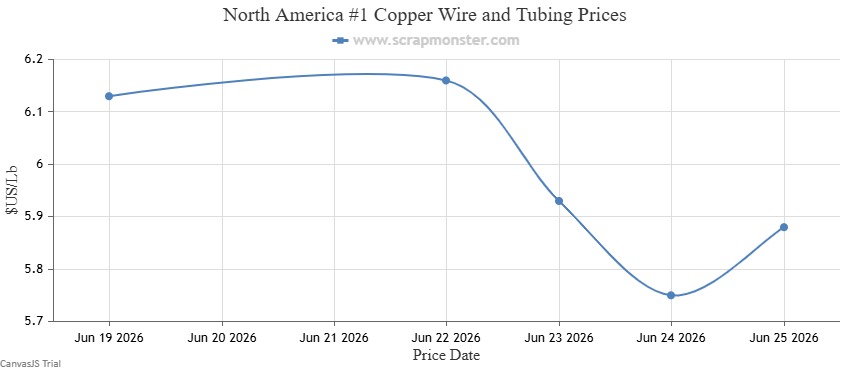
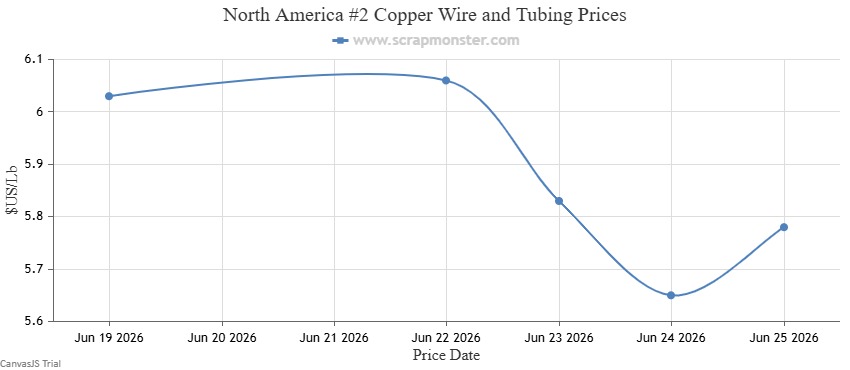
The table below highlights the week-on-week price movements for #1 Copper Bare Bright, #1 Copper Wire and Tubing, and #2 Copper Wire and Tubing.
| Category | Price Change ($) | % Change |
| #1 Copper Bare Bright | 0.25 | -4.01% |
| #1 Copper Wire and Tubing | 0.25 | -4.08% |
| #2 Copper Wire and Tubing | 0.25 | -4.15% |
Access our Daily Scrap Metal Price Report Hub
Track real-time prices via our US Scrap Price Index
USA East Coast Copper Scrap Prices
Copper scrap prices extended their downward trend on the Scrap Monster Price Index during the week ending June 25, 2026. #1 Copper Bare Bright declined by $0.25 per pound, representing a ↓4.01% week-on-week drop. #1 Copper Wire and Tubing also lost $0.25 per pound, down ↓4.08% from the previous week. Among the major copper grades, #2 Copper Wire and Tubing registered the sharpest weekly decline, falling ↓4.22%.
USA Midwest Copper Scrap Prices
Copper scrap values weakened further on the Scrap Monster Price Index during the week ending Thursday, June 25, 2026. #1 Copper Bare Bright dropped by $0.25 per pound, marking a ↓4.14% decline from the previous week. #1 Copper Wire & Tubing also shed $0.25 per pound, translating to a ↓4.21% week-on-week decrease. Among the leading copper grades, #2 Copper Wire and Tubing posted the largest percentage loss, falling ↓4.28% over the week to close at a lower level.
USA West Coast Copper Scrap Prices
Copper scrap prices on the U.S. West Coast remained under pressure during the week ending June 25, 2026, according to the Scrap Monster Price Index. #1 Copper Bare Bright declined by $0.25 per pound, representing a ↓3.95% week-on-week drop. #1 Copper Wire & Tubing also lost $0.25 per pound, down ↓4.01% from the previous week. Meanwhile, #2 Copper Wire and Tubing continued its downward trajectory, recording a ↓4.08% weekly decline.
International Comparison
China Copper Scrap Prices
- All leading copper scrap categories posted modest declines on the Scrap Monster Price Index.
- The steepest declines during the week were recorded by #2 Copper Wire and Tubing, which fell ↓3.60%. #1 Copper Wire and Tubing and #1 Insulated Copper Wire 85% Recovery followed closely, with both grades posting identical week-on-week declines of ↓3.56%.
India Copper Scrap Prices
- All copper scrap categories recorded a week-over-week dip on the Scrap Monster Price Index.
- The commodity to report the biggest fall in prices was Copper sheet cutting, whose prices were down by INR 69,000 per Ton(↓7.90%).
ALUMINUM SCRAP PRICES
- COMEX Aluminum Futures closed at USD 3,173.25 per metric ton as of June 25, 2026, modestly lower when compared with the previous week's closing price of USD 3,400.85 per metric ton.
- LME Aluminum 3-month contract closed at $3,164.50 per tonne, according to the London Metal Exchange.
Market Highlights
North America Aluminum Scrap Prices: Aluminum scrap prices continued to weaken during the week under review, with most major grades registering notable losses on the Scrap Monster Price Index. E.C. Aluminum Wire recorded the steepest decline, dropping $0.11 per pound, or ↓7.19% week on week. 6063 Extrusions fell by $0.06 per pound, while Old Cast retreated by $0.05 per pound. UBC prices also moved lower, declining $0.05 per pound, equivalent to a ↓5.32% decrease from the previous week's level.
Charts
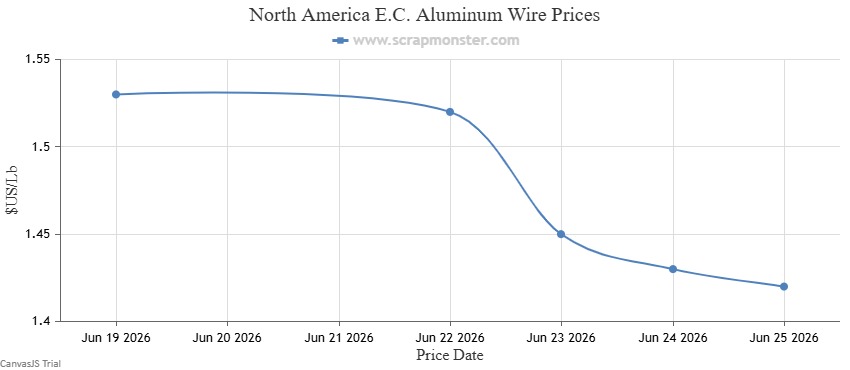
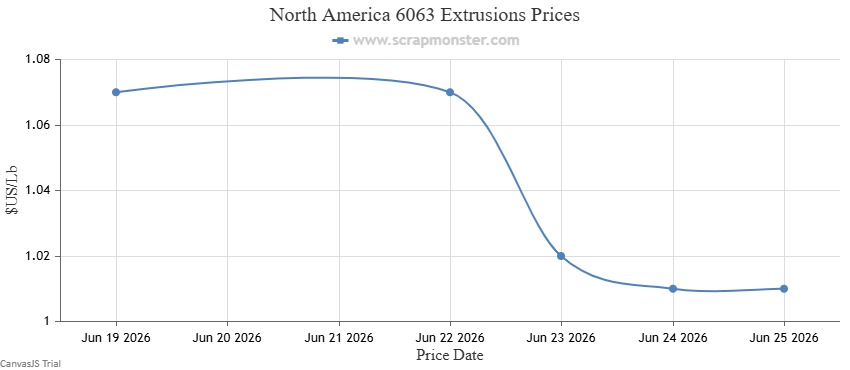
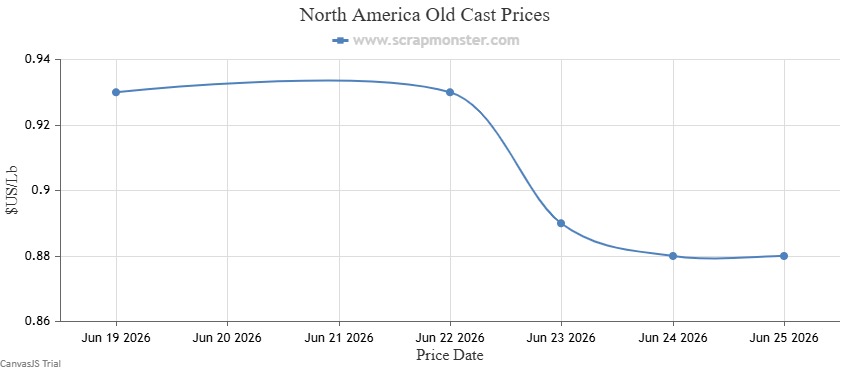
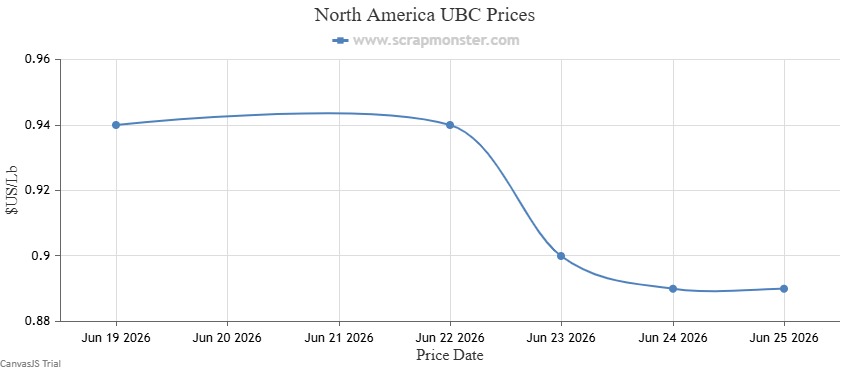
The table below provides weekly price fluctuations in E.C. Aluminum Wire, 6063 Extrusions, Old Cast and UBC.
Category | Price Change ($) | % Change |
0.11 | -7.19% | |
0.06 | -5.61% | |
0.06 | -5.38% | |
0.05 | -5.32% |
Access our Daily Scrap Metal Price Report Hub
Track real-time prices via our US Scrap Price Index
USA East Coast Aluminum Scrap Prices
The aluminum scrap market remained on a downward trajectory during the week, with widespread price declines across major grades. E.C. Aluminum Wire led the losses, falling ↓7.19% week on week. Other benchmark grades, including 6063 Extrusions, Old Cast, and UBC, also posted declines, reflecting continued weak demand and subdued market sentiment.
USA Midwest Aluminum Scrap Prices
Aluminum scrap prices weakened across the board during the past week, with several benchmark grades recording notable losses. E.C. Aluminum Wire posted the sharpest decline, falling $0.11 per pound, or ↓7.19%, from the previous week. 6063 Extrusions followed with a $0.06 per pound decrease, equivalent to a ↓5.61% drop. Old Cast also retreated by $0.05 per pound on a week-on-week basis, while UBC prices slipped by the same amount over the period.
USA West Coast Aluminum Scrap Prices
Aluminum scrap prices remained under pressure on the Scrap Monster Price Index during the week ending June 25, 2026. E.C. Aluminum Wire recorded the steepest decline, falling $0.11 per pound from the previous week's level. 6063 Extrusions also weakened, shedding $0.06 per pound. Old Cast prices declined by $0.05 per pound, representing a ↓5.32% week-on-week decrease, while UBC prices also slipped by $0.05 per pound over the same period, extending the broader downward trend in the aluminum scrap market.
International Comparison
China Aluminum Scrap Prices
- All aluminum scrap categories recorded a modest decline from the previous week's prices on the Scrap Monster Price Index.
- Old Cast and Old Sheet posted the biggest dips, falling by CNY 1,100 per MT (↓5.12%) each.
India Aluminum Scrap Prices
- All aluminum scrap categories recorded a dip on the Scrap Monster Price Index.
- Aluminum utensil scrap and aluminum ingot prices moved lower during the week, with both categories recording an identical decline of INR 26,000 per ton compared with the previous reporting period.
- On a week-on-week basis, Aluminum utensil scrap registered the sharpest decline among the tracked grades, dropping ↓7.47%.
BRASS/BRONZE SCRAP PRICES
Market Highlights
North America Brass/Bronze Scrap Prices: Brass and bronze scrap prices edged lower over the past week, reflecting softness in the market. Yellow Brass declined by $0.09 per pound, marking a ↓2.59% week-on-week decrease. Red Brass also moved lower, losing $0.09 per pound during the same period to finish the week at a weaker level.
Charts
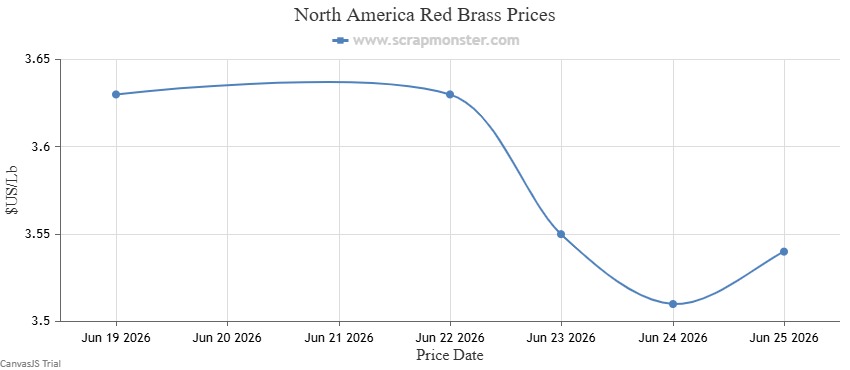
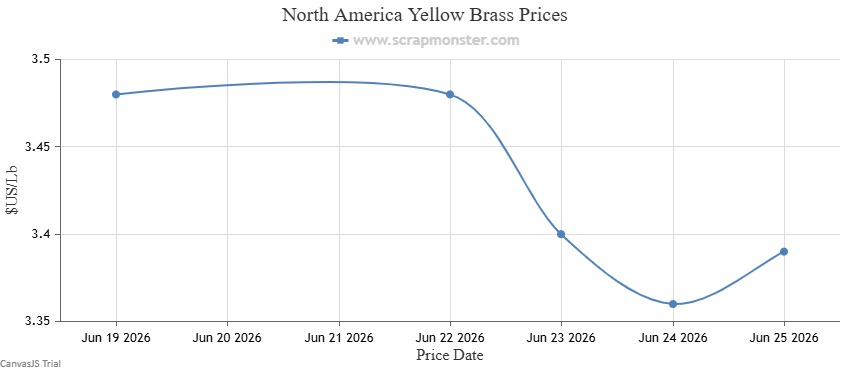
The table below provides weekly price fluctuations in Yellow Brass and Red Brass.
Category | Price Change ($) | % Change |
0.09 | -2.48% | |
0.09 | -2.59% |
Access our Daily Scrap Metal Price Report Hub
Track real-time prices via our US Scrap Price Index
USA East Coast Brass/Bronze Scrap Prices
On the Scrap Monster Price Index, Red Brass prices dropped by $0.09 per Lb as of Thursday, June 25, 2026. Yellow Brass also posted a dip in prices, down by $0.09 per Lb on the Index.
USA Midwest Brass/Bronze Scrap Prices
By the end of the week that ended June 25, 2026, Red Brass prices had dipped by $0.09 per Lb compared to the start of the week. Yellow Brass also recorded a week-on-week decline, edging lower by $0.09 per Lb (↓2.65%).
USA West Coast Brass/Bronze Scrap Prices
Red Brass prices dipped by $0.09 per pound, marking a ↓2.40% decline from the previous week. Also, Yellow Brass prices moved lower, recording a dip of approximately $0.09 per pound on the Scrap Monster Price Index by week’s end.
International Comparison
China Brass/Bronze Scrap Prices
- All brass/bronze scrap categories recorded slight decline on the Scrap Monster Price Index.
- Both Red Brass and Yellow Brass prices were down by CNY 650 per MT.
India Brass/Bronze Scrap Prices
- All brass/bronze scrap categories recorded week-over-week dip on the Scrap Monster Price Index.
- Top Loser: Brass Cuttings, which was down by INR 24,000 per Ton (↓5.69%)
LEAD SCRAP PRICES
- COMEX Lead Futures recorded a decline of USD 39.05 per Ton (↓2.00%) over the prior week to close at USD 1,917.68 per Ton as of June 25, 2026.
- The closing price of LME Lead 3-month contract was $1,912.50 per metric tonne, as per London Metal Exchange data.
Market Highlights
North America Lead Scrap Prices: Lead scrap prices remained unchanged throughout the week, reflecting balanced market conditions and steady supply-demand dynamics. Scrap auto battery prices also showed no movement, ending the week at the same levels as the previous reporting period.
Chart
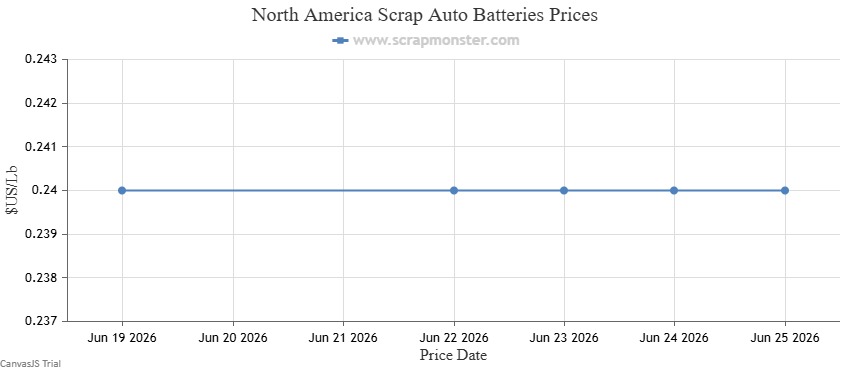
The table below provides weekly price fluctuations in Scrap Auto Batteries.
Category | Price Change ($) | % Change |
0 | Nil |
Access our Daily Scrap Metal Price Report Hub
Track real-time prices via our US Scrap Price Index
USA East Coast Lead Scrap Prices
The price of Scrap Auto Batteries on the Scrap Monster Price Index held steady as of Thursday, June 25, 2026.
USA Midwest Lead Scrap Prices
Scrap auto battery prices remained stable during the week ending June 25, 2026, with no change recorded compared to the previous week's levels.
USA West Coast Lead Scrap Prices
The prices of Scrap Auto Batteries recorded no change on the Scrap Monster Price Index as of Thursday, June 25, 2026.
International Comparison
China Lead Scrap Prices
- Soft Lead and #2 Lead scrap prices posted a marginal week-on-week decline of CNY 100 per MT each on the Scrap Monster Price Index.
- In the meantime, Auto Battery prices recorded a dip of ↓0.76% from the prior week's prices.
India Lead Scrap Prices
- The prices of all lead scrap categories in the region edged lower over the previous week on the Scrap Monster Price Index.
ZINC SCRAP PRICES
- COMEX Zinc Futures closed at USD 3,443.85 per metric ton as of June 25, 2026, recording a notable decline of USD 119.60 per metric ton (↓3.36%).
- LME Zinc 3-month contract's closing price on the London Metal Exchange: $3,434.50 per tonne
Market Highlights
North America Zinc Scrap Prices: Zinc scrap prices weakened during the week under review. New Zinc Die Cast prices slipped by $0.01 per pound, or ↓1.16%, from the previous week, while Old Zinc Die Cast also declined by $0.01 per pound, or ↓1.27%, on the Scrap Monster Price Index.
Charts
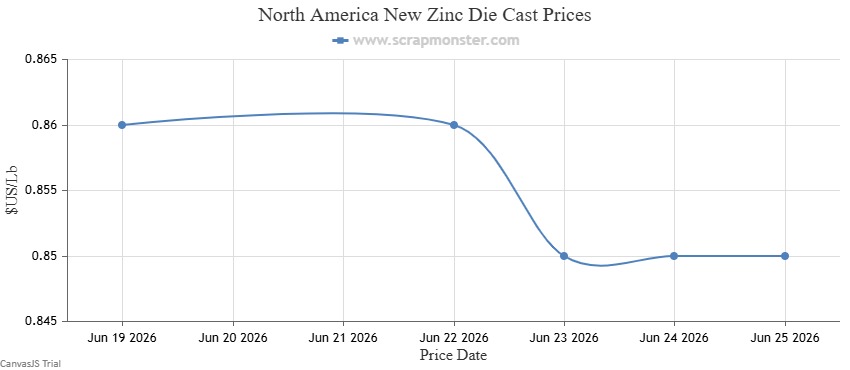
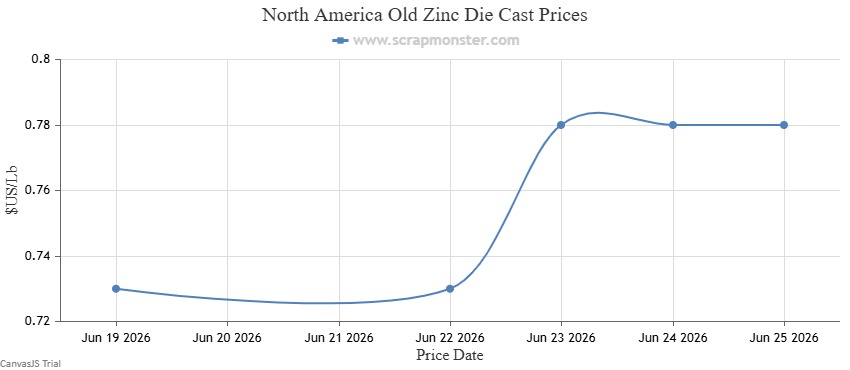
The table below provides weekly price fluctuations in New Zinc Die Cast and Old Zinc Die Cast.
Category | Price Change ($) | % Change |
0.01 | -1.16% | |
0.01 | -1.27% |
Access our Daily Scrap Metal Price Report Hub
Track real-time prices via our US Scrap Price Index
USA East Coast Zinc Scrap Prices
The price of New Zinc Die Cast on the Scrap Monster Price Index recorded a decline of ↓1.16% as of Thursday, June 25, 2026. Old Zinc Die Cast also moved lower, falling ↓1.27% from the previous week.
USA Midwest Zinc Scrap Prices
The zinc scrap market moved lower during the week ending June 25, 2026. New Zinc Die Cast declined by ↓1.16% week over week, while Old Zinc Die Cast also slipped by ↓1.27% on the Scrap Monster Price Index.
USA West Coast Zinc Scrap Prices
Zinc scrap prices weakened on the Scrap Monster Price Index during the week ended June 25, 2026. New Zinc Die Cast prices fell ↓1.16% from their prior week’s levels, while Old Zinc Die Cast prices declined ↓1.27% over the same period.
International Comparison
- Shred zinc scrap prices recorded a decline of CNY 350 per MT on the Scrap Monster Price Index. The commodity's price was down by ↓2.06% from the previous week's price during the week ended June 25, 2026.
- Tin Slab prices held steady week-over-week on the Scrap Monster Price Index.
- Zinc slab prices witnessed a decline of ↓3.53% over the previous week
FERROUS SCRAP
Market Drivers
Steel Production Levels
Steel mill operating rates remain the primary determinant of ferrous scrap demand. Higher production of long and flat steel products increases scrap consumption, particularly among electric arc furnace (EAF) producers. Conversely, production curtailments caused by weak steel demand, maintenance outages, or poor mill margins reduce scrap purchasing volumes and weigh on prices.Scrap Generation and Collection Rates
The supply of obsolete and prompt scrap depends on construction activity, manufacturing output, vehicle scrappage, demolition projects, and industrial production. Lower industrial activity or seasonal disruptions can restrict scrap flows, tightening supply even when steel demand is subdued. Collection economics also influence whether suppliers release material into the market.Electric Arc Furnace (EAF) Capacity Expansion
The continued global shift toward EAF steelmaking is increasing structural demand for high-quality ferrous scrap. New EAF projects in North America, Europe, the Middle East, and parts of Asia are expected to raise scrap consumption over the medium term, although regional availability of prime scrap remains a constraint.International Trade Flows and Export Policies
Changes in export demand, freight costs, tariffs, quotas, and export restrictions can significantly influence regional scrap prices. Major exporting regions such as the United States, the European Union, Japan, and the United Kingdom, along with large importing markets including Türkiye, India, Bangladesh, and Vietnam, continue to shape global price direction through changing trade patterns.Steel Demand from End-Use Industries
Construction, infrastructure, automotive, machinery, shipbuilding, and manufacturing sectors directly affect steel consumption and, in turn, scrap demand. Government infrastructure spending and industrial investment can provide support, while weakness in residential construction or manufacturing slows scrap purchasing.Iron Ore and Metallic Raw Material Prices
The relative prices of iron ore, pig iron, direct reduced iron (DRI), hot briquetted iron (HBI), and scrap influence steelmakers' raw material choices. Higher prices for virgin metallics generally improve scrap's competitiveness, while lower iron ore or pig iron prices may encourage mills to substitute away from scrap where technically feasible.
The near- to medium-term ferrous scrap market is expected to be shaped by a balance between moderate steel demand recovery and structural growth in EAF steelmaking, against the backdrop of uncertain global economic conditions.
STEEL SCRAP PRICES
Market Highlights
The closing price of various LME 2-month steel contracts on the London Metal Exchange as of June 25, 2026 is provided below:
Steel Scrap CFR Turkey (Platts) - $381.50 per tonne
Steel Rebar FOB Turkey (Platts) - $583.00 per tonne
Steel Scrap CFR India (Platts) - $385.00 per tonne
North America Steel Scrap Prices: Steel scrap prices mostly edged higher, with a few categories holding steady week-on-week. #1 HMS held firm at prior-week levels, while Shredded Auto Scrap prices increased !10 per ton, or ↑2.41%. HMS 80/20 prices were up by ↑1.75%, while #1 Busheling witnessed a sharper increase, surging ↑9.76%.
According to the American Iron and Steel Institute (AISI), U.S. raw steel production totalled 1.851 million NT during the week ended June 20, 2026. This is ↓0.20% week-on-week and ↑3.30% year-on-year.
The capability utilization rate stood at 80.2% (compared to 80.3% in the week ending June 13, 2026).
Region-wise production - Northeast-129,000 NT, Great Lakes-496,000 NT, Midwest-318,000 NT, Southern-833,000 NT, Western-75,000 NT
Charts
.jpeg)
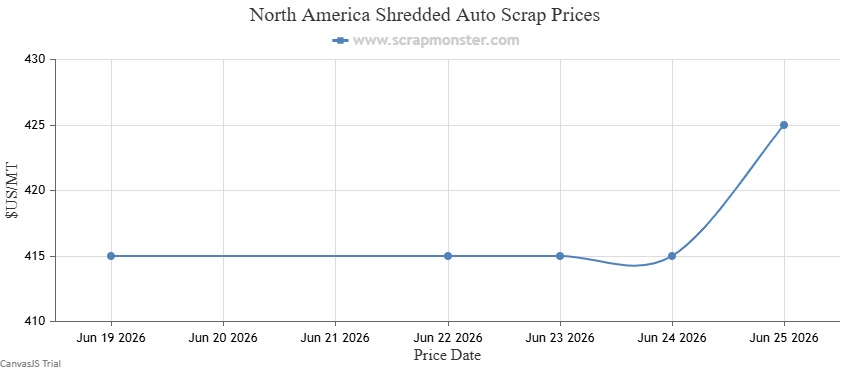
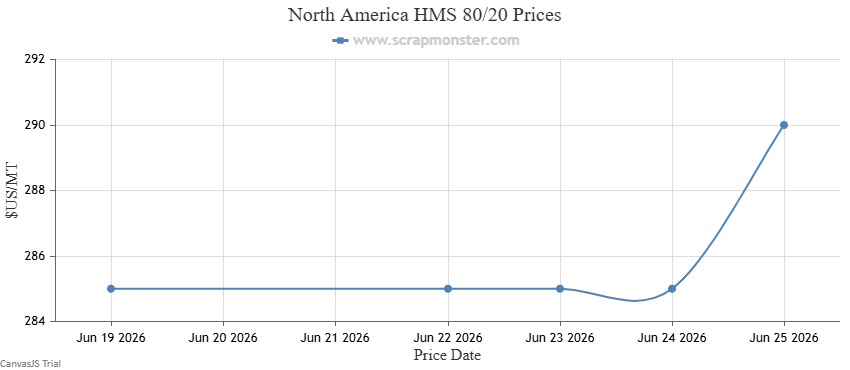
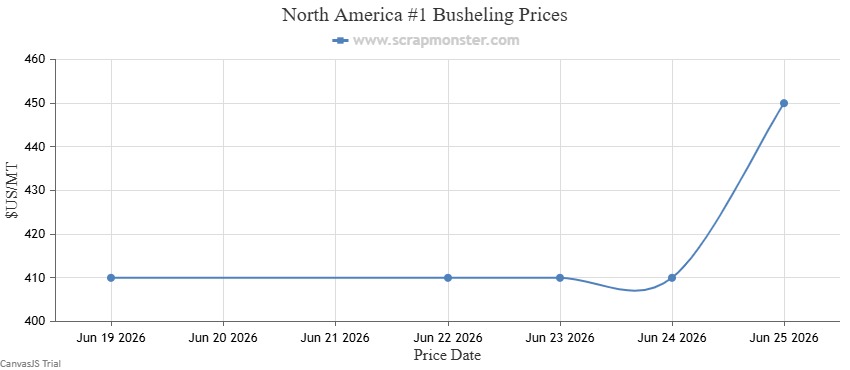
The table below provides weekly price variations in #1 HMS, Shredded Auto Scrap, HMS 80/20, and #1 Busheling.
Category | Price Change ($) | % Change |
0 | Nil | |
10 | +2.41% | |
5 | +1.75% | |
40 | +9.76% |
Access our Daily Scrap Metal Price Report Hub
Track real-time prices via our US Scrap Price Index
USA East Coast Steel Scrap Prices
Ferrous scrap prices, except for a few listed grades, edged higher during the week ended June 25, 2026, according to the Scrap Monster Price Index, reflecting renewed market momentum. #1 HMS prices were flat on the Index. However, all other major benchmark grades, including Shredded Auto Scrap, HMS 80/20, and #1 Busheling, moved higher from the previous week's level.
USA Midwest Steel Scrap Prices
#1 HMS prices held steady on the Scrap Monster Price Index during the week. Meanwhile, Shredded Auto Scrap, HMS 80/20, and #1 Busheling all posted week-on-week gains, reflecting firmer pricing across several key ferrous scrap grades.
USA West Coast Steel Scrap Prices
Ferrous scrap prices displayed a generally firmer trend during the week ending June 25, 2026, with most benchmark grades advancing on the Scrap Monster Price Index. #1 HMS remained unchanged throughout the reporting period, while Shredded Auto Scrap, HMS 80/20, and #1 Busheling all recorded modest week-on-week gains, indicating improved pricing across the broader ferrous scrap market.
International Comparison
China Flat
China Steel Scrap Prices
- All the steel scrap categories held steady on the Scrap Monster Price Index.
- #1 HMS and Cast Iron Scrap prices remained flat upon comparison with the previous week's prices.
STAINLESS STEEL SCRAP PRICES
Market Highlights
North America Stainless Steel Scrap Prices: The stainless steel scrap market traded downwards over the previous week, with prices edging lower across key grades. Notably, 304 SS Solid scrap prices were down by ↓3.03% from the prior week's level on the Scrap Monster Price Index.
Chart
.jpeg)
The table below provides weekly price fluctuations in 304 SS Solid scrap.
Category | Price Change ($) | % Change |
0.02 | -3.03% |
Access our Daily Scrap Metal Price Report Hub
Track real-time prices via our US Scrap Price Index
USA East Coast Stainless Steel Scrap Prices
The price of 304 SS Solid on the Scrap Monster Price Index recorded a decline of ↓3.03% as of Thursday, June 25, 2026.
USA Midwest Stainless Steel Scrap Prices
304 SS Solid prices registered a dip of ↓3.03% on the Scrap Monster Price Index. The price of the commodity fell by $0.02 per Lb during the week.
USA West Coast Stainless Steel Scrap Prices
According to the Scrap Monster Price Index, the price of 304 SS Solid dropped by ↓3.03% during the week ended June 25, 2026, recording a week-on-week dip of $0.02 per Lb.
International Comparison
China ↓3.85%
China Stainless Steel Scrap Prices
- All stainless steel scrap categories recorded decline on the Scrap Monster Price Index.
- Top Losers: 201 SS ↓4.80%, 304 SS Turning ↓4.21%
See all Stainless steel daily reports → | Stainless Steel Price Index → | Related Stainless steel news →
Weekly Market Drivers
- U.S. Steel Mill Production- U.S. Raw Steel Production Up 3.3% YoY, Weekly Output Slips Slightly
- Steel Mill Investment- U.S. Steel announces $475 million investment in Fairfield Tubular Operations
- Global Steel Output- worldsteel: Global Crude Steel Output Down Slightly in May
- Green Steel- SSAB, Greenbier, Alter Partner on Circular Steel Recycling Project
- Steelmaking Industry- Great Lakes Steelmaking at a Crossroads
- New Steel Mill- Apple Grove's Nucor steel mill approaches final stages of construction
- Direct Reduced Iron- Midrex to build a DRI production plant for US Steel
Global Comparison & Policy Impact
USA vs. China/India
Expert Quote:
"The market remains broadly balanced, with expectations centered on only a modest month-on-month increase rather than a significant jump in ferrous scrap prices." — James McCulloch, Principal Analyst, Ferrous Scrap, Fastmarkets (published in the US Scrap Trends Outlook – June 2026).
Market Outlook
Steel Demand Recovery Will Be Gradual
Ferrous scrap demand is expected to improve only gradually as steel consumption recovers unevenly across regions. Infrastructure projects and industrial activity are likely to provide support, but weakness in residential construction and slower manufacturing growth in some economies may limit the pace of recovery.Electric Arc Furnace Expansion Will Support Long-Term Demand
The continued commissioning of electric arc furnace (EAF) steel plants will provide a structural boost to scrap consumption. As steelmakers pursue lower-carbon production routes, demand for high-quality ferrous scrap is expected to remain on an upward trajectory despite periodic fluctuations in steel output.Scrap Supply Will Remain Regionally Tight
Obsolete scrap generation is unlikely to increase significantly in the near term due to subdued construction and demolition activity in several markets. Prime industrial scrap availability may also remain constrained if manufacturing output does not accelerate, supporting prices during periods of stronger mill demand.- Export Markets Will Continue to Influence Prices
International trade is expected to remain a major price driver. Purchasing activity from major importing countries, freight costs, currency movements, and potential trade policy changes will continue to create regional price volatility and influence the competitiveness of exporting nations. - Price Volatility Is Likely to Persist
Ferrous scrap prices are expected to remain volatile as markets react to changing steel production levels, seasonal supply patterns, raw material costs, and macroeconomic developments. Monthly buying cycles and shifting mill inventories are likely to result in frequent price adjustments. - Sustainability Will Strengthen Scrap's Strategic Importance
Growing emphasis on decarbonization, circular economy initiatives, and carbon emission reduction targets will continue to enhance the strategic role of ferrous scrap in steelmaking. Increasing regulatory and customer pressure for lower-carbon steel is expected to support sustained investment in scrap-based production.
The near- to medium-term outlook for the ferrous scrap market is cautiously constructive. Structural factors—particularly the global transition toward EAF steelmaking and sustainability-driven steel production—provide a positive foundation for demand. However, the market is expected to remain sensitive to fluctuations in steel production, international trade flows, scrap availability, and broader economic conditions, resulting in continued regional differences and periodic price volatility.
WATCHLIST FOR UPCOMING WEEK
U.S
- Tue: JOLTS Job Openings and S&P Case-Shiller Home Price Index.
- Wed: ADP Employment Change, final S&P Manufacturing PMI, and ISM Manufacturing index.
- Thu: U.S. Employment Report (Non-Farm Payrolls, Unemployment Rate, Hourly Wages), Initial Jobless Claims, and Factory Orders.
Europe (EU & UK)
- Mon: Eurozone Business and Consumer Confidence.
- Tue: German Retail Sales and Eurozone preliminary CPI (Inflation).
- Wed: German Unemployment Rate and Eurozone Manufacturing PMI.
- Thu: Eurozone Unemployment Rate and ECB Meeting Minutes.
Asia & Oceania
- Tue: Japan Industrial Production and Retail Sales.
- Wed: China Manufacturing PMI (official and Caixin), and Japan Tankan Survey.
- Thu: Australian Trade Balance and Retail Sales.
Daily Reports | Scrap Monster Price Index | US Scrap Metal Prices
Register now for free daily alerts → Sign Up
Related Resources
Copper Scrap Prices | Aluminum Scrap Prices | Steel Scrap Prices | Brass Scrap Prices | Scrap Yard Directory | Company Directory | Daily Market Report
Full pricing details, yard finder, market analysis, and live price charts available at ScrapMonster.com. Trusted by 100,000+ recycling professionals. Sign up for daily alerts—your competitive edge starts here.
POLL
What do you expect to have the biggest impact on scrap metal prices over the next few months?
Frequently Asked Questions
- Which scrap metal segment performed best during the week?
Ferrous scrap outperformed other categories, with most steel scrap grades posting weekly gains, supported by steady mill demand and improving market momentum.
- Which non-ferrous metals recorded the biggest declines?
Copper and aluminum scrap registered the sharpest weakness, while brass and stainless steel also moved lower. Lead remained largely stable, and zinc showed mixed performance.
- What factors are expected to influence the scrap market in the coming months?
Steel production levels, EAF capacity expansion, industrial demand, scrap availability, global trade policies, infrastructure spending, and broader economic conditions will remain the key market drivers.
- How can I track scrap metal prices in real time?
For up-to-date data, use tools like the Scrap Monster Price Index and the US Scrap Price Index, then review daily and weekly reports in the Scrap Monster portal to monitor trends, percentage moves, and grade-specific performance.
Combining index data with structured weekly commentary helps scrap yards, traders, and generators refine their buying and selling strategies.
- Which zinc scrap category gained during the week?
Old Zinc Die Cast, which increased by 6.85%.
- What are the major drivers of the non-ferrous scrap market?
Industrial demand, energy transition, global economic growth, scrap availability, government policies, and currency movements.
- What are the key drivers of the ferrous scrap market?
Steel production, scrap generation, EAF expansion, international trade, end-use steel demand, and iron ore prices.