 By
By 
What Is a Strip Brush? Uses, Types and How to Choose the Right One
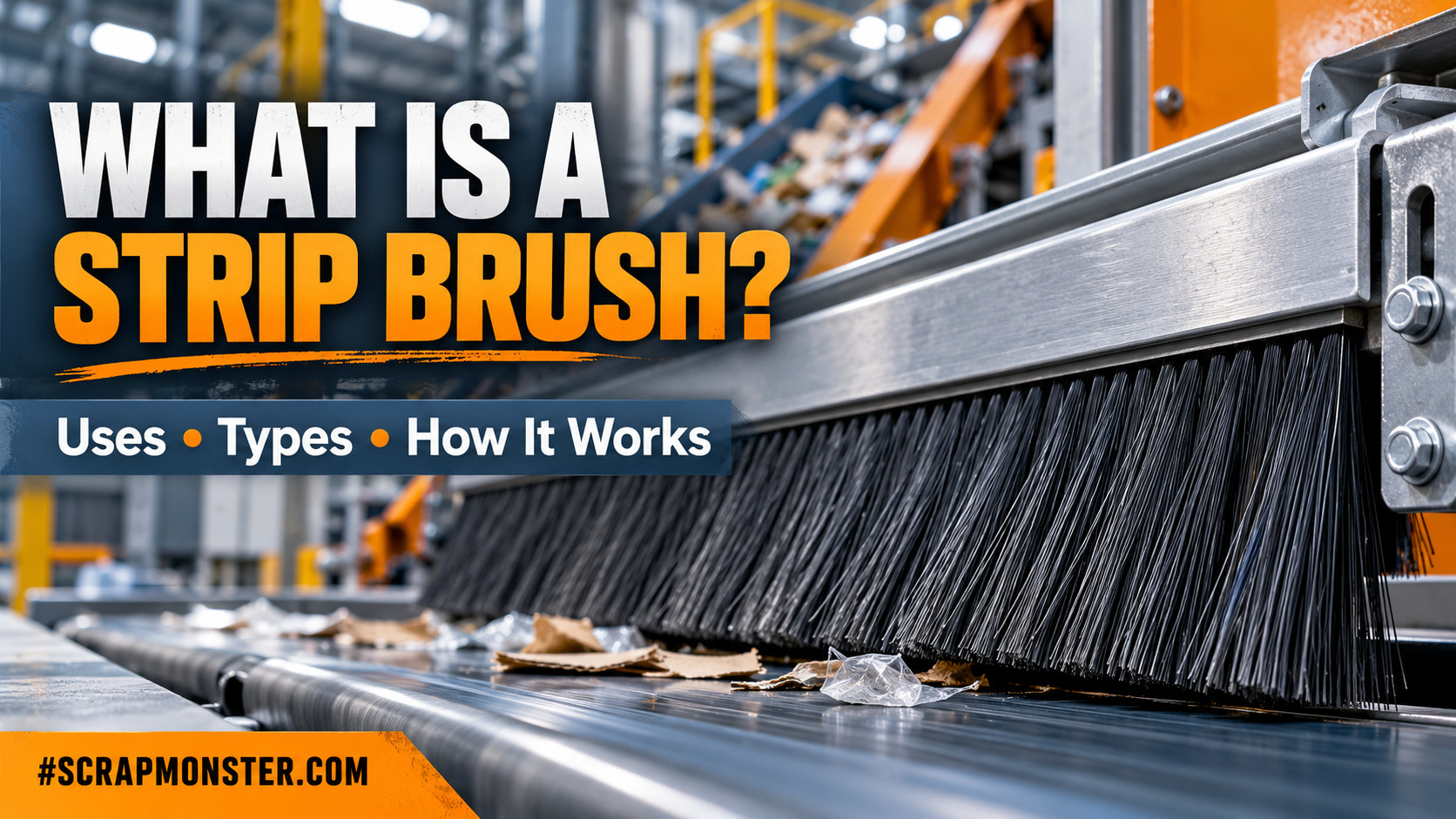
A strip brush is a long, narrow brush made by securing densely packed bristles into a continuous backing or channel. It creates a flexible contact surface that can seal gaps, clean conveyors, guide products, block dust, control airflow, remove debris, reduce static and protect machinery without the rigid contact of a solid barrier.
Strip brushes are easy to overlook because they are simple components. In an industrial setting, however, that simplicity is exactly what makes them useful.
A well-chosen strip brush can solve problems that would otherwise require a more complicated guard, seal, scraper or cleaning system. It can make light contact with moving products, conform to uneven surfaces and continue working even when the size or position of the material changes slightly.
Strip Brushes at a Glance
- What it is: A continuous row of bristles secured in a metal or flexible backing.
- What it does: Seals, cleans, wipes, guides, separates, contains or protects.
- Common materials: Nylon, polypropylene, natural fibers, brass, stainless steel and conductive or anti-static filaments.
- Common industries: Manufacturing, recycling, material handling, packaging, transportation, food processing, warehousing and construction.
- Why use one: It provides flexible contact without creating a hard obstruction.
- Common forms: Straight strip brushes, flexible strips, formed strips and coiled or cylindrical configurations.
What Exactly Is a Strip Brush?
Most traditional industrial strip brushes, also called channel brushes or metal channel strip brushes, are made by placing bristle material around a retaining wire and securing it inside a U-shaped metal channel.
The channel is crimped around the bristles and retaining wire to hold them in place. The result is a continuous brush that can be manufactured in long straight sections or formed into other configurations.
The bristles can be natural, synthetic or metallic depending on what the brush needs to do.
Flexible strip brushes use a bendable backing instead of a conventional rigid metal channel. These are useful where the brush needs to follow curves or irregular shapes.
How Does a Strip Brush Work?
A strip brush works by allowing thousands of individual bristles to flex independently when they contact an object or surface.
That is the key difference between a brush seal and a solid rubber, plastic or metal barrier.
A solid seal normally has to match the opening closely. A strip brush can tolerate small differences in shape, height and position because the bristles bend around whatever passes through them.
Imagine a conveyor carrying boxes of slightly different sizes. A rigid guide could jam or damage an oversized carton. A properly selected strip brush can gently contact the boxes while still allowing them to move.
The same principle makes strip brushes useful around doors, machinery openings, cable penetrations and production equipment.
Why Are Strip Brushes Useful?
Strip brushes solve a surprisingly wide range of everyday industrial problems.
1. They Seal Without Creating a Hard Barrier
A strip brush can close or partially close a gap while still allowing objects, cables, equipment or people to pass through.
This makes brush seals useful for controlling:
- Dust
- Dirt
- Light
- Air movement
- Mist
- Fumes
- Rain and snow
- Insects
- Loose debris
Transportation-grade strip brushes, for example, are used around doors and openings as flexible shields against air, dirt, rain, snow and other contamination.
2. They Clean Moving Surfaces Continuously
A strip brush positioned against a conveyor belt can wipe material away every time the belt passes.
This can reduce manual cleaning and help prevent loose material from accumulating around machinery.
Strip brushes are also used for surface cleaning, filter and screen cleaning, glass washing and other continuous cleaning operations.
3. They Guide Products Without Damaging Them
Flexible bristles can guide, stabilize, separate or hold down products moving through a conveyor or production line.
Applications include:
- Keeping products centered on conveyors
- Preventing lightweight items from lifting
- Separating products as they move
- Redirecting items at transfer points
- Controlling sheets, paper or packaging
4. They Can Help Control Static Electricity
Special conductive or static-dissipative strip brushes can be used where static buildup is a concern.
These brushes are particularly relevant in applications involving electronics, printing, plastics, packaging and other operations where electrostatic charge can interfere with production or attract contamination.
5. They Can Protect Equipment and Work Areas
Strip brushes can act as:
- Machine guards
- Splash curtains
- Chip containment barriers
- Skirting
- Dust barriers
- Cable-management seals
Because the bristles flex, the brush can provide protection while maintaining access or movement through the opening.
ScrapMonster Intelligence: Why Strip Brushes Matter in Recycling Operations
Recycling plants are a natural application for strip brushes because material is constantly moving. Conveyors, sorting lines, screens and transfer points all create opportunities for dust, fines and small pieces of material to escape or accumulate.
A strip brush can be positioned beside or above moving material to guide products, contain light debris or continuously wipe a surface.
They can also solve small problems before those problems require larger equipment changes. A plant dealing with material drifting from one side of a conveyor may not need an entirely new conveying system. A correctly positioned guide brush may provide sufficient control.
The value is usually operational rather than dramatic. Strip brushes do not replace proper guards, engineered dust-control systems or safety equipment. Their strength is in providing simple, flexible contact where a rigid component would be impractical.
Recycling operators evaluating conveyors, sorting systems and other plant equipment can explore the ScrapMonster Recycling Equipment Directory and industry company directory for additional equipment and supplier resources.
Where Are Strip Brushes Used?
Strip brushes are used across a wide range of industrial and commercial environments.
| Application | What the Strip Brush Does |
|---|---|
| Conveyor systems | Cleans belts, guides products, contains debris or holds lightweight material down. |
| Recycling and material recovery | Helps control fines, guide material and clean or protect conveying equipment. |
| Doors and loading docks | Closes irregular gaps while allowing movement. |
| Manufacturing equipment | Contains chips, dust, spray or debris near machinery openings. |
| Packaging lines | Guides, separates or stabilizes cartons and products. |
| Transportation | Provides flexible weather and contamination seals around doors and equipment. |
| Data centers and cabinets | Seals openings around cables and helps manage unwanted airflow. |
| Food processing | Can clean, guide or handle products when appropriate food-compatible materials are used. |
| Printing | Can hold or guide sheets and assist with static-control applications. |
| Construction and buildings | Acts as weather stripping, door sealing or pest-control barrier. |
Who Needs a Strip Brush?
You may need a strip brush if you are responsible for equipment or processes where something needs to be sealed, cleaned, guided, contained or protected without completely blocking movement.
Typical users include:
- Recycling facilities and material recovery facilities
- Scrap processors
- Manufacturing plants
- Warehouse and distribution centers
- Conveyor-system operators
- Packaging companies
- Food processors
- Printing companies
- Transportation equipment manufacturers
- Door and dock equipment installers
- Machine builders
- Maintenance departments
- Automation engineers
What Are Strip Brush Bristles Made From?
The fill material is one of the most important decisions when choosing a strip brush because it determines how the brush behaves against the product or surface.
| Bristle Material | Typical Characteristics | Common Uses |
|---|---|---|
| Nylon | Durable, flexible, abrasion-resistant and good at recovering after bending. | Sealing, wiping, guiding, conveyor cleaning and general industrial use. |
| Polypropylene | Synthetic filament used where moisture or chemical exposure may influence material choice. | General sealing and industrial applications. |
| Stainless steel | More aggressive than nylon and resistant to corrosion. | High-temperature, wet, corrosive or more aggressive brushing applications. |
| Brass | Metal filament that is softer than many steel options and corrosion resistant. | Applications requiring metal filament with less aggressive contact. |
| Horsehair | Soft natural filament suited to dust and fine-particle handling. | Dusting, polishing and delicate contact. |
| Conductive / static-dissipative filament | Designed for applications where electrostatic charge must be managed. | Electronics, printing, plastics and static-sensitive production lines. |
How Do You Choose the Right Strip Brush?
Choosing a strip brush is less about finding the “best” brush and more about finding the brush that fits the application.
Before ordering one, answer the following questions.
1. What Do You Need the Brush to Do?
Start with the job.
Do you need to:
- Seal an opening?
- Clean a conveyor?
- Block dust?
- Guide a product?
- Hold material down?
- Contain chips?
- Reduce static?
- Protect an opening?
The function determines nearly every specification that follows.
2. How Much Contact Should the Bristles Make?
A sealing brush may only need enough contact to close a gap.
A cleaning brush may require firmer contact.
Too little contact can make the brush ineffective. Too much interference can increase drag, bend the bristles excessively or shorten brush life.
3. What Bristle Material Is Appropriate?
Consider:
- Temperature
- Moisture
- Chemical exposure
- Abrasiveness
- Static-control requirements
- Surface sensitivity
- Food-contact requirements
For example, stainless steel can be appropriate in wet or higher-temperature environments where corrosion resistance matters. Carbon steel should not automatically be substituted in wet environments because it can rust, and using inappropriate wire on softer or dissimilar metals can contaminate the work surface.
4. How Long Should the Bristles Be?
This measurement is generally called the trim length.
Longer bristles usually provide greater flexibility and reach. Shorter bristles are generally stiffer.
The correct length depends on the size of the gap and how much resistance the application requires.
5. How Dense Should the Brush Be?
Dense bristles can improve sealing and containment, while a more open brush may be appropriate when products must pass through with minimal resistance.
6. What Backing Material Do You Need?
Metal-backed strip brushes are commonly available with galvanized or stainless-steel channels. Holders may also be manufactured from aluminum or stainless steel.
Corrosive, wet or hygienic environments may justify stainless components.
7. Is a Straight Brush Actually the Right Shape?
Strip brushes do not have to remain straight.
Manufacturers can configure them as:
- Straight strips
- Formed curves
- Ovals
- Rectangles
- L-shapes
- V-shapes
- Coiled brushes
- Cylindrical brushes
If a straight strip cannot follow the equipment geometry, a formed or flexible strip may solve the problem more effectively.
Strip Brush vs. Rubber Seal: Which Is Better?
Neither is universally better. They solve different problems.
| Requirement | Strip Brush | Solid Rubber Seal |
|---|---|---|
| Handles irregular shapes | Very well | Depends on seal design |
| Allows products to pass through | Yes | More resistance |
| Complete air/water seal | Limited | Usually better |
| Guides moving material | Excellent | Not normally its main purpose |
| Continuous wiping | Yes | Possible but different behavior |
If you need an airtight or watertight seal, a brush may not be the right solution. If you need a barrier that accommodates movement or irregular objects, a strip brush can be much more practical.
How to Install and Use a Strip Brush
The exact installation depends on the equipment, but most straight strip brushes are installed in a holder or attached so that the bristles make controlled contact with the target surface.
Step 1: Measure the Opening or Contact Area
Measure the:
- Total brush length required
- Gap height or width
- Desired overlap or bristle contact
- Available mounting space
Step 2: Select the Brush and Holder
Make sure the brush backing matches the holder or mounting method.
Industrial holders are available in different channel sizes and configurations, so the brush and holder should be specified together.
Step 3: Position the Bristles Correctly
For sealing, the bristles should overlap the opening enough to create a consistent barrier.
For conveyor cleaning, they should make sufficient contact to remove debris without producing unnecessary drag.
Step 4: Secure the Holder
Mount the holder firmly to a stable surface using the attachment method appropriate for the equipment.
On machinery, installation should never interfere with guards, emergency stops or other safety systems.
Step 5: Test Under Real Operating Conditions
Run the equipment and check:
- Brush deflection
- Product movement
- Cleaning effectiveness
- Excessive resistance
- Bristle wear
- Material buildup
Small adjustments to angle or contact pressure can make a significant difference.
Common Mistakes When Buying a Strip Brush
Choosing Only by Length
Overall length is only one specification. Fill material, trim length, bristle diameter, backing size and density can completely change brush performance.
Using Bristles That Are Too Stiff
A stiffer brush is not automatically better. Excessive stiffness can increase friction or damage sensitive products.
Using Bristles That Are Too Soft
If the brush cannot maintain contact, it will not clean, guide or seal effectively.
Ignoring the Environment
Heat, moisture, chemicals and corrosion can quickly make the wrong brush material unsuitable.
Expecting a Strip Brush to Replace Safety Equipment
A strip brush can help contain debris or cover an opening, but it is not automatically a machine guard or personnel-safety barrier.
Applications involving hazardous moving machinery should use properly engineered safety systems.
How Long Does a Strip Brush Last?
There is no universal service-life figure.
Wear depends on:
- Operating speed
- Contact pressure
- Filament material
- Abrasiveness of the product
- Temperature
- Chemical exposure
- How many hours per day the brush operates
A lightly loaded door seal may last far longer than a strip brush continuously wiping an abrasive conveyor belt.
Inspect industrial strip brushes periodically for uneven wear, bent bristles, missing filament, backing damage or reduced contact.
When Should You Replace a Strip Brush?
Replace or adjust the brush when:
- The bristles no longer contact the intended surface.
- Dust or debris begins passing through the seal.
- Conveyor cleaning becomes less effective.
- The bristles remain permanently bent.
- Sections of filament are missing.
- The metal backing or holder is loose or damaged.
- The brush begins interfering with normal product movement.
Do You Need a Custom Strip Brush?
Standard brushes work well when the required length, trim, filament and channel dimensions already exist.
A custom brush may make sense when you need:
- A non-standard length
- A specific filament
- Unusual trim height
- Higher or lower bristle density
- A curved or formed brush
- Special temperature resistance
- Static-control properties
- A specific backing material
- A brush designed around existing machinery
Industrial manufacturers routinely offer multiple filament materials, channel sizes, trim lengths and custom configurations.
The Bottom Line
A strip brush is one of those industrial components that can look almost too simple to matter. In the right application, however, it can solve a problem cleanly and inexpensively.
If you need to seal a changing gap, wipe a moving surface, guide products, contain dust, manage static or protect an opening while still allowing movement, a strip brush is worth considering.
The key is not simply buying a brush. It is matching the filament, stiffness, trim length, density, backing and mounting method to the job.
When those variables are right, a strip brush can perform continuously with little complexity and become one of the least noticeable—but most useful—components on the equipment.