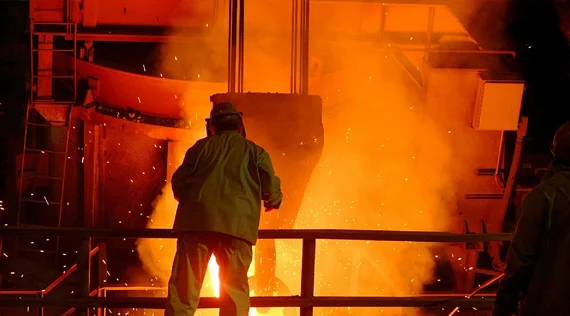
Pittsburgh steel industry celebrates its role in building America
Steel News | 2026-06-17 05:13:33
Rivers of Steel’s director said the organization aims to preserve steelworkers' stories while training the next generation of workers through programs in metal arts and traditional trades.
 By Paul Ploumis
SEATTLE (Scrap Monster): As America celebrates her 250th birthday this year, the American steel industry celebrates its role in helping to build the country.
"Knowing my grandfather did this before me, that he made this possible for me to be able to do this,” said Keli Vereb, a steelworker at US Steel’s Mon Valley Works, a sprawling complex of factories crisscrossing the Monongahela River, just upstream of Pittsburgh. "It's pride that we make the steel here that makes a lot of things around the world. Back in the day, it built the bridges and the Empire State Building. There's pride. We see that logo on things. You know, my washer and dryer was made with steel from my plant."
Starting in the mid 1800’s steel formed the backbone of the nation in the form of railroads, bridges and skyscrapers.
"Pittsburgh changed the world."
Ron Baraff is a historian with Rivers of Steel, a preservation non-profit organization.
"Pittsburgh changed the world. This city literally and figuratively built the 20th century," he said.
Just like steel, an alloy requiring specific ingredients like iron ore and carbon, Pittsburgh had all the ingredients necessary to launch a global industry.
Geologists call the Pittsburgh Coal Seam the most economically important mineral deposit in the world.
The Monongahela, the Allegheny, and the Ohio Rivers serve as an easy way to transport raw materials like iron ore, coal, and limestone. The famous Pittsburgh Three Rivers also helped distribute the final product of steel to the world. But the most important ingredient Pittsburgh had was its people.
"A strong back, people to work hard, to move this machine forward." Ron Baraff from Rivers of Steel. "They came from all over the world originally. Who's being attracted here to work in this industry? It's Northern Europeans, Germans, Dutch, and English. Why? Because they have that background. They're working in the iron industry, in the coal industry in Europe."
One of those Northern European immigrants would briefly become the world’s richest man. Andrew Carnegie’s company, eventually called United States Steel, was the first billion-dollar company in the world.
Baraff said Carnegie valued innovation.
"If something new was coming along that would change the industry, that would allow him to produce not just a cheaper steel, but a better steel. He would invest in capital, and that's what allowed for success," Baraff said.
Carnegie lived on Pittsburgh’s Millionaires’ Row, miles from the mills that pumped out profits and pollution.
In 1892, his partner Henry Clay Frick successfully busted the union at the company’s Homestead works. Seven union workers and three Pinkertons would die at the Battle of Homestead. After Homestead, American steelworkers would not have union representation for another 40 years. But when the unions returned, they helped create the very idea of a middle class, lifting millions of people out of poverty.
"To say we deserve a seat at the table. We deserve a piece of the American dream that our labor, our sweat equity, is just as important as Andrew Carnegie's capital," Baraff said.
The decline in Western Pennsylvania
After 100 years of steel dominating life in Western Pennsylvania, 150,000 steel jobs evaporated from the region.
"It was every other house, every one of your neighbors had somebody, a brother, sister, uncle, mom, dad, somebody that worked here," Keli Vereb remembers.
From 1948 to 1952, the Marshall Plan meant America helped build brand new steel mills with the latest technology in Germany and Japan. It appeared that mid-century American steel bosses lost sight of Andrew Carnegie’s spirit of innovation and investment. In the Pittsburgh region, U.S. Steel, now owned by Japan-based Nippon Steel, still uses equipment built in the 1930’s.
Baraff says the entire American steel industry lost its way.
"There's something about being on top for so long where you become complacent and think that this is the way we've always done it. Let's not change it. But what ends up happening, certainly post-World War II, is that countries like Germany and Japan push ahead of us," Baraff said.
At its peak, 95,000 steelworkers clocked in at the Mon Valley Works. That number now stands at 3,000.
Like Keli Vereb, they clock in with pride and hope for the future, "and these jobs are more than just jobs here. It's the survival of the communities that we live in."
The future of steel in Pittsburgh
The steel industry in Pittsburgh is set for a major transformation with Nippon Steel and U.S. Steel announcing a $2.5 billion investment in the Mon Valley Works, a series of steel mills along the Monongahela River.
“That was a hard pill to swallow. I mean, because this is my history here, but, you know, as long as they're the promises that they've made to invest here, that's the critical point. They'll win more people over by, you know, following through and, you know, not shutting down plants,” Vereb said.
Last Monday, U.S. Commerce Secretary Gina Raimondo joined U.S. Steel CEO David Burritt under the American flag to announce the investment, which increased from $1.5 billion to $2.5 billion.
Nippon Steel plans to begin construction this year. The plan includes decommissioning the hot strip mill at U.S. Steel's Irvin Works in West Mifflin and building a new hot strip mill at Edgar Thompson Works in Braddock. The project will create thousands of temporary construction jobs and maintain the current workforce of about 3,000 steelworkers once operational.
“And I have to say the people who made it happen, let's start with the steelworkers, give yourself a big round of applause. The community and the community leaders who stood up for American steel, thank you so very much,” Burritt said.
Near Braddock, the historic Carrie Furnaces, now preserved by Rivers of Steel, showcase the region’s steel history. Before the nonprofit took over Carnegie’s first plant, ironworker artists illegally created sculptures, including a massive deer head, which visitors can now see.
Rivers of Steel’s director said the organization aims to preserve steelworkers' stories while training the next generation of workers through programs in metal arts and traditional trades.
“Our focus there is on traditional trades that can support the gaps in the manufacturing industries in the region. So, and they make it, it’s learned earn, they get paid rather than learning where they’re paying to learn and hoping to get a job. They’re actually learning on-site, fixing things here. So adding incredible value to us and then setting themself up as a pre-apprentice for future opportunities,” Mary W. Murrin said.
Rivers of Steel graduated its first cohort of trainees this summer, with all participants securing jobs after completing the program.
Courtesy: www.wtae.com