Chinese scientists recover 98% of gold from old phones in 20 minutes at low cost
E-waste Recycling | 2026-01-09 11:20:51
The mechanism eliminates the need for corrosive reagents or external catalysts.
 By Paul Ploumis
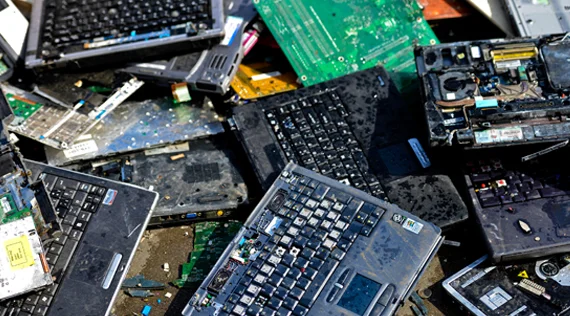
SEATTLE (Scrap Monster): Chinese researchers have discovered a fast, low-cost and environmentally cleaner method for extracting gold from electronic waste, that could significantly reshape e-waste recycling worldwide and reduce the need for traditional mining.
The novel technique, that can extract gold from discarded electronics in under 20 minutes at room temperature was developed by researchers from the Guangzhou Institute of Energy Conversion under the Chinese Academy of Sciences and South China University of Technology.
The team reported that the new process costs about one-third of current market prices for gold recovery which makes it the most cost-efficient method reported to date.
It also achieves more than 98.2 percent gold leaching efficiency from waste CPUs (central processing units) in old mobile phones and PCBs (printed circuit boards) from home appliances at room temperature.
Fast, cheap gold recycling
Electronic waste, or e-waste, is one of the fastest growing solid waste streams in the world. As per the World Health Organization (WHO), the annual generation of e-waste is rising by 2.6 million tons. It is expected to climb to 82 million tons by 2030.
The most common e-waste items include computers, large household appliances, mobile phones and medical equipment. These items contain small but valuable amounts of precious metals, including gold (Au) and palladium (Pd) which are widely used for their excellent conductivity, stability and corrosion resistance.
Meanwhile, conventional recycling methods often rely on toxic chemicals such as cyanide, posing serious environmental and health risks. To address the challenge the team developed a process based on a self-catalytic leaching mechanism.
The mechanism eliminates the need for corrosive reagents or external catalysts. In contrast it uses a simple aqueous solution of potassium peroxymonosulfate (PMS) and potassium chloride (KCl). When the solution comes into contact with gold or palladium surfaces, the metals themselves behave as catalysts. On the metal surface, PMS and chloride ions (Cl⁻) are activated, producing highly reactive oxidants such as singlet oxygen and hypochlorous acid.
These oxidants then break down the metal atoms, and allow the chloride ions to bind to them and dissolve them into the solution for easy recovery. For the study, the team carried out quenching experiments and spectroscopic analysis.
Courtesy: www.interestingengineering.com