 By
AI Method Cuts E-Waste Image Processing Time Sixfold
Researchers at Australia's Monash University have developed an artificial intelligence method that reduces electronic-waste image processing time by approximately sixfold while maintaining reliable recognition accuracy. The approach could help make future automated e-waste sorting systems more adaptable and less computationally demanding.
By Paul Ploumis
Published: October 27, 2026
Study published: October 26, 2026
Key Points
- Processing speed: Approximately sixfold reduction in processing time compared with the tested fine-tuning method.
- AI technology: Models adapt during image analysis instead of requiring extensive offline retraining.
- Training data: Targeted reference images reduce the need for specialized labeled data.
- Industry application: Findings could support future automated e-waste recognition, but commercial performance remains unproven.
MONTREAL (Scrap Monster): Researchers at Monash University have developed a more efficient artificial intelligence method for identifying electronic waste in complex images, potentially addressing one of the technical challenges facing automated recycling systems.
The study, published in Scientific Reports on October 26, 2026, was conducted by Aseni Senanayake, Mehrtash Harandi, Nilakshan Kunananthaseelan and Mehrdad Arashpour.
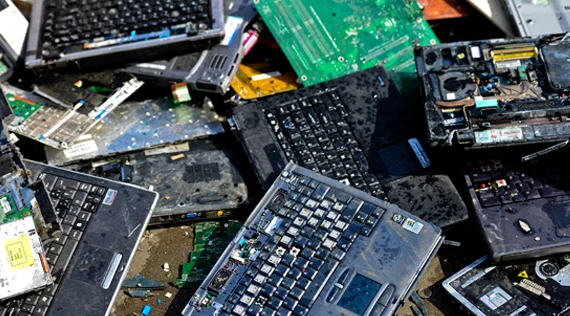
Electronic waste presents difficulties for computer-vision systems because devices and components frequently overlap, appear damaged or are partially hidden. Training conventional AI models to identify these materials requires substantial computing power and extensive labeled image datasets.
New AI Method Reduces Training Requirements
The researchers developed an approach called test-time fine-tuning, allowing pretrained vision models to adapt while processing new images rather than undergoing lengthy retraining beforehand.
The method uses an active retrieval system to select a small group of relevant reference images. It first identifies visually similar examples, then selects those offering useful additional information without unnecessary duplication.
In tests using a curated e-waste image dataset, the system reduced end-to-end processing time by approximately sixfold compared with parameter-efficient fine-tuning while maintaining reliable image segmentation accuracy.
Image segmentation allows AI software to identify and distinguish individual objects or regions within a complex image, an important capability for future automated sorting and disassembly applications.
ScrapMonster Edge: Sixfold Faster AI Does Not Mean Sixfold Faster Recycling
The reported improvement applies specifically to AI image processing, not the physical sorting speed or material recovery rate of a recycling facility.
The researchers tested their method on a curated dataset rather than an operating industrial recycling line.
For e-waste processors, the potential value lies in recognizing varied electronic components with less specialized training and computing time. Whether this produces measurable improvements in sorting efficiency, recovery rates or operating costs will require industrial validation.
Research Could Support More Adaptable Recycling Systems
The findings provide a foundation for developing AI systems capable of handling the varied materials and unpredictable conditions encountered in electronics recycling.
However, commercial deployment will require further testing under real processing conditions, including integration with sorting equipment and evaluation of operational performance.
The full study, Test-time fine-tuning of large-scale vision foundation models for data-efficient electronic waste segmentation, is available through Scientific Reports.
Research: Scientific Reports, October 26, 2026.
Courtesy: www.bioengineer.org